

Infections are among the most common adverse events affecting patients in hospital settings, and hand hygiene is a primary measure for disease prevention. This study analyzed the impact of using ozonated water as an adjuvant in reducing microorganisms present on the hands of surgical teams before pediatric cardiovascular operations, and on the hands of nurses working in the Intensive Care Unit (ICU). Over one year, a quantitative microbiological analysis was conducted on 224 hand surface samples from 10 ICU professionals and 5 surgical center professionals, which constituted the study material. Samples were collected at two distinct times: before and after hand hygiene and rinsing with either water without ozone or ozonated water. There was a 100% reduction in the number of Colony-Forming Units (CFU) in surgical center samples after rinsing with ozonated water, with p=0.0029 for the left hand and p=0.0156 for the right hand. Hands rinsed with water without ozone showed CFU reduction in 6 (86%) and 4 (80%) cases, considering the left hand (n=7) and right hand (n=5), respectively. In hand samples from ICU professionals, after rinsing with ozonated water, 82% (n=14) showed CFU reduction for the left hand (p=0.0469) and the right hand (p=0.0195). For hands rinsed with water without ozone, there was a 47% (n=7) reduction in microbial load for both hands. This study confirms that rinsing hands with ozonated water, as an adjuvant to hygiene practices, consistently reduces microbial load when compared to rinsing with water without ozone, thereby minimizing the risk of transmission to other surfaces.
Keywords: Hand hygiene, Hand disinfection, Ozonated water
Hand hygiene is a fundamental and vitally important measure in preventing and controlling Healthcare-Associated Infections (HAIs), including those caused by antibiotic-resistant organisms, significantly contributing to patient safety.1,2 Healthcare professionals' hands are recognized as the primary route for transmitting microorganisms, both transient and permanent, during care delivery, acting as reservoirs that facilitate the spread of pathogens between patients and professionals.3,4
In hospital settings, the epidemiology of HAIs is complex and influenced by multiple factors, including patient location, length of stay (especially in Intensive Care Units - ICU), and specific clinical practices, such as managing patients with surgical site infections, catheter-associated infections, or those on mechanical ventilation.5 Despite the existence of well-established protocols for hand hygiene and environmental disinfection, the transfer of pathogens, including multidrug-resistant bacteria, persists as a significant challenge.6,7 The era of antimicrobial multidrug resistance accentuates the critical need not only to adhere to existing protocols but also to explore associative or alternative practices to optimize hand disinfection and minimize the risks of maintaining and spreading infectious diseases.6,8 However, the effective implementation of these practices faces obstacles, such as variable adherence to protocols and difficulty in monitoring the techniques employed.9
In this context, the search for effective adjuvant strategies for hand hygiene is highly relevant. Ozone (O3), an allotropic form of oxygen generated by corona discharge, is known for its high oxidizing and disinfectant power.10 Its antimicrobial properties are efficient in both gaseous form and when dissolved in water, offering a relatively simple production process.11,12 The use of ozonated water for hand rinsing, within concentration standards permitted by regulatory bodies like ANVISA and international entities, emerges as a technically feasible alternative to aid in microbial control.10
However, despite ozone's known antimicrobial properties11,12 and its potential viability for use in hygiene,10 existing literature still shows gaps regarding the specific evaluation of ozonated water's effectiveness when used as an adjuvant to standard hand hygiene methods. A robust quantitative analysis of its impact on reducing cutaneous microbial load in practical application scenarios is lacking. Identifying and quantifying the additional benefit of rinsing with ozonated water can provide crucial data to optimize hygiene protocols. Therefore, the objective of this study was to analyze the impact of using ozonated water as an adjuvant in hand hygiene on the reduction of microbial load.
To quantitatively analyze the microbiota present on the hands of healthcare professionals in surgical centers and intensive care units, both before and after performing a hygiene protocol, with rinsing using either common water or ozonated water as an adjuvant process.
Type of study
This was an experimental study conducted among surgical center and ICU professionals, comparing hand microbiota before and after conventional hygiene, and then rinsing with the addition of ozone as an adjuvant to conventional hygiene protocols.
The selection of surgical center professionals included only those who actively participated in the surgical field. Among ICU professionals, 10 assisting nurses were chosen, representing ten percent of the total staff in that department.
Over a one-year period, 224 hand surface samples were collected: 112 from 5 surgical center professionals and 112 from 10 ICU professionals. In the surgical center, samples were collected before and after the scrubbing procedure, using the conventional hygiene protocol, with half of the samples involving rinsing with common water and the other half with ozonated water. Among ICU professionals, 36 samples involved rinsing with ozonated water and the remainder with common water, with microbiota compared before and after hygiene.
Hand hygiene procedure
Following the protocol proposed by the Ministry of Health and ANVISA, published in "Patient Safety in Health Services: Hand Hygiene, 2009," the hands of surgical center professionals were supervised during hygiene, specifically considering surgical antisepsis or pre-operative hand preparation. Their hands were evaluated for the presence of microorganisms before and after conventional hygiene, using 22 mL of a 2% chlorhexidine digluconate solution (Riohex® 2%).
The technique used for surgical antisepsis or pre-operative hand preparation, as recommended by ANVISA, should last three to five minutes, adhering to the following steps:
- 1. Turn on the faucet and wet hands, forearms, and elbows
- 2. Collect antiseptic in cupped hands and spread it over hands, forearms, and elbows. If using a brush impregnated with antiseptic, press the impregnated part of the sponge against the skin and spread over all parts of the hands, forearms, and elbows
- 3. Clean under fingernails with the brush bristles
- 4. Rub hands, paying attention to interdigital spaces, and forearms for a minimum of three to five minutes, keeping hands above elbows
- 5. Rinse hands under running water, from hands towards elbows, removing all product residue. Turn off the faucet with an elbow, knee, or foot if the faucet does not have a photosensor
- 6. Dry hands with sterile towels or compresses using blotting motions, starting with the hands and moving towards forearms and elbows, taking care to use different folds of the towel/compress for distinct areas.
For the ICU, supervised hand hygiene followed the guidelines for Simple Hand Hygiene, published in "Patient Safety in Health Services: Hand Hygiene." The hygiene chemical used was Clean & Smooth Classic ECOLAB® liquid soap, 3 mL, applied for 1 minute with standard hygiene movements.
The technique used for the Simple Hand Hygiene procedure, recommended by ANVISA, should last forty to sixty seconds, adhering to the following steps:
- 1. Turn on the faucet and wet hands, avoiding contact with the sink
- 2. Apply enough liquid soap to the palm of the hand to cover the entire hand surface (follow the manufacturer's recommended quantity)
- 3. Lather palms, rubbing them together
- 4. Rub the palm of the right hand over the back of the left hand, interlacing fingers, and vice-versa
- 5. Interlace fingers and rub the interdigital spaces
- 6. Rub the backs of the fingers of one hand with the palm of the opposite hand, holding the fingers, with a back-and-forth motion, and vice-versa
- 7. Rub the right thumb with the aid of the left palm, performing a circular motion, and vice-versa
- 8. Rub the fingertips and fingernails of the left hand against the right palm, cupped, making a circular motion, and vice-versa
- 9. Rub the left wrist with the aid of the right palm, performing a circular motion, and vice-versa
- 10. Rinse hands, removing soap residue. Avoid direct contact of soapy hands with the faucet
- 11. Dry hands with a disposable paper towel, starting with the hands and moving towards the wrists. If the faucet requires manual contact to close, always use a paper towel
Analysis of hand microbiota
Collection was performed using swabs, pre-moistened in sterile saline solution and scraped across the palmar, lateral, and interdigital areas, both before and after hand hygiene for both the right and left hands.
After this process, the swab was immersed in a test tube containing 100 µL of sterile saline solution and immediately transported to the Microbiology Laboratory at the Faculdade de Medicina de São José do Rio Preto (FAMERP). The samples were then homogenized in a shaker, and 100 µL were inoculated into BHI Agar, followed by streaking with a sterile disposable Drigalski spreader on the surface of the agar in a Petri dish. Incubation occurred in a bacteriological oven at 36.5 ºC for 24 hours. After the incubation period, the plates were evaluated by counting Colony-Forming Units (CFU) per mL.
Analysis of water physicochemical parameters
During the experiment, with and without ozone generation, the following parameters were measured: temperature, chlorine concentration, pH, ozone concentration, and water flow rate. The faucets generating ozonated water were standardized to produce 0.6 ppm of ozone with a flow rate of 8 L/minute.
Statistical analysis
The Wilcoxon test was used to assess differences in CFU values before and after hand hygiene, with and without ozonated water. The Mann-Whitney test was employed to determine if the CFU count differed when using ozonated water versus the traditional procedure. A P-value < 0.05 was considered statistically significant.
Ozone concentration records in the water showed a variation between 0.5 and 0.6 ppm, consistently with a flow rate of 8 L/minute. The water temperature distributed through the hospital network ranged between 24 and 25ºC, and the residual chlorine concentration was between 1.25 and 1.6 mg/L, confirming the quality of the water supplied to the hospital network.
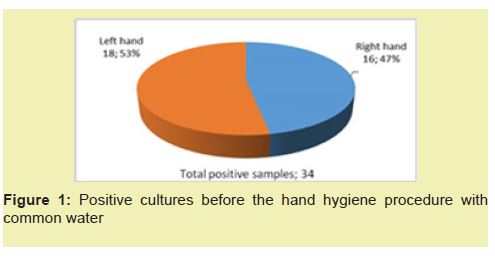
Microbiological analysis of the hands of surgical center professionals before brushing procedures (n=56) revealed the presence of bacteria in 18 left hand samples and 16 right hand samples Figure 1. Maximum and minimum CFU/mL counts were 62 and 1 for the left hand, and 80 and 1 for the right hand. Cultures were negative in the first collection for 38 left hand samples and 40 right hand samples.
After the brushing procedure and rinsing with common water, 1 left hand sample that had shown no microbial growth in the first collection became positive, with 1 CFU/mL.
Considering the totality of positive cultures for the left hand (N=7) and right hand (n=5) after the brushing procedure and rinsing without ozone, CFU reduction occurred in 6 (86%) and 4 (80%) samples, respectively. Although contamination reduction occurred, there was no significant difference in the reduction of CFU values when comparing hands before and after rinsing with common water; left hand (p=0.0625) and right hand (p=0.25).
Considering the microbial analysis protocol before and after brushing and rinsing with ozonated water (i.e., 22 collections), there was a 100% reduction in the number of CFUs for both hands. Additionally, three samples that were negative before the protocol became positive after brushing and rinsing with ozonated water, with 2 samples from the left hand and only 1 from the right hand.
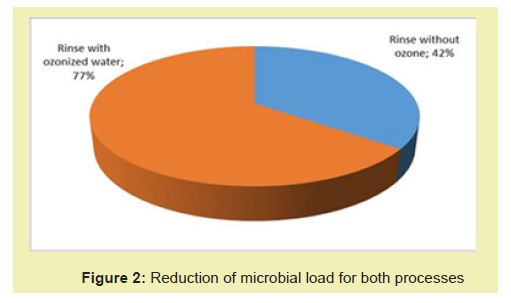
When evaluating positive cultures for both processes, rinsing with common water and with ozonated water, it was observed that for the former, there was a 42% reduction in microbial load for both hands, and for the latter, a 77% reduction Figure 2. Comparing the left and right hands when using ozonated water for rinsing, a significant difference was found in the reduction of CFU values, with p=0.0029 and p=0.0156, respectively.
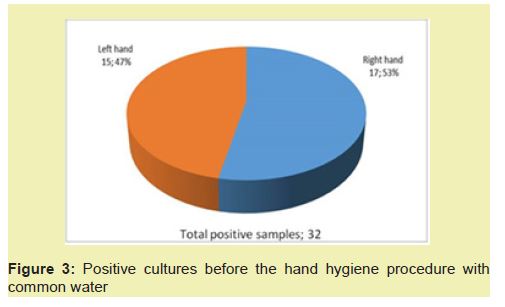
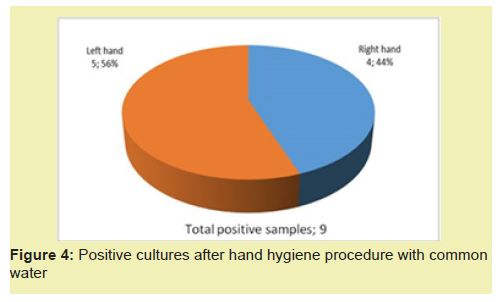
Microbiological analysis of the hands of ICU professionals before hygiene procedures (n=36) revealed the presence of bacteria in 32 (88.9%) samples, with 15 from the left hand and 17 from the right hand Figure 3. The maximum and minimum CFU/mL counts were 160 and 1 for the left hand, and 212 and 2 for the right hand, for the group that rinsed with common water. In this group, 2 out of 3 (16.7%) samples that were originally negative became positive after hygiene with common water. Additionally, 15 samples that were already positive in the first collection showed an increase in CFU/mL count in 9 cases (60%), with 5 (56%) on the left hand and 4 (44%) on the right Figure 4.
Considering rinsing with common water, in 9 collections performed from each hand before the washing procedure, they remained positive after the procedure: 9 (100%) from the left hand and 8 (89%) from the right.
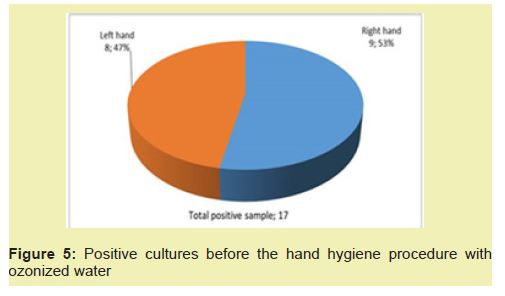
Before the hygiene procedures and rinsing with ozonated water, 17 microbial cultures from the hands of ICU professionals were positive for bacteria (94.4%). These showed maximum and minimum CFU/mL counts of 248 and 5 for the left hand, and 164 and 5 for the right hand. Within this group, 14 (82%) showed a reduction in CFUs after rinsing. Additionally, for the total positive cultures before and after the brushing procedure and rinsing with ozonated water, (n=8) for the left hand and (n=9) for the right hand, there was a reduction of 75% and 89%, respectively Figure 5.
In the positive cultures for both processes, it was observed that with rinsing using common water, there was a 47% (n=7) reduction in microbial load for both hands, and with rinsing using ozonated water, an 82% (n=14) reduction Figure 6.
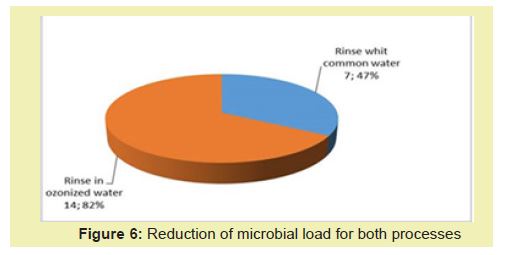
When comparing the left and right hands using ozonated water, there was a significant difference in the reduction of CFU values, with p=0.0469 for the left hand and p=0.0195 for the right hand.
Our study demonstrated that both the hand scrubbing procedure and simple hand hygiene were of vital importance before surgical procedures and before ICU professionals began providing care. This was evident from the considerable reduction in CFU count, irrespective of whether ozonated water was used. In a 2021 study, Murata and colleagues reaffirmed the importance of ozonated water in disinfection and its use in hospital settings across various protocols, such as cleaning hands and surfaces.13
Healthcare professionals can be considered reservoirs for microorganisms and, consequently, promote the circulation and transmission of resistant bacteria in the hospital environment. Between 10.5% and 78.3% of these professionals, when colonized with Staphylococcus aureus, spread this bacterial species into the environment.14
According to ANVISA, surgical hand antisepsis with an antiseptic-impregnated brush is an important measure, among others, for preventing surgical site infections. Its purpose is to eliminate transient skin microbiota and reduce resident microbiota.14-17 However, this procedure can result in skin damage, shedding of superficial skin layers, and microscopic cuts on the skin's surface. Adopting these antiseptics significantly increases costs due to the large number of scrub brushes used in daily hospital routines,18,19 in addition to challenges in monitoring and observing the correct application of hand hygiene techniques.9
Besides these observations, rinse water from hospital reservoirs can have a high percentage of microorganisms, favoring biofilm formation in the pipes and consequently continuously disseminating bacteria and fungi.20,21
Due to its high oxidizing power, ozone has been used in gas form or dissolved in water as an antimicrobial agent for disinfection, being considered a viable and low-cost alternative for inactivating fungi, viruses, and bacteria.12 The results presented here demonstrated that ozonated water can be considered an associative alternative to hand hygiene protocols in the hospital sector, showing significant reductions in microbial load after hand rinsing, just as other studies affirm the same efficacy.13,22
Appelgrein and colleagues, despite not finding a statistical difference between protocols, proved a statistical difference in the reduction of CFU count after rinsing using 4 ppm ozonated water with p=0.001.23 Corroborating this statement, other studies have also proven the inactivation of various microorganisms, suggesting it could be a suitable substitute for alcohol sprays, with advantages like the absence of allergic reactions and less skin aggression, a fact commonly observed with chemical products.13,22-24
These data make the implementation of an ozonated water generator system feasible in hospital areas with higher risk of microbial transfer.
With the advent of the SARS-CoV-2 pandemic, the use of disinfectant solutions became a daily habit. It's believed that, due to this fact, bacterial colonization on individuals' hands was lower in the original samples.
Other important factors that likely influenced the results are related to the temperature and residual chlorine effect in the water distributed through the hospital network, considering variations between 1.25 and 1.6 mg/L for chlorine in our faucets and 24 and 25ºC for water temperature. Residual chlorine in pipelines is required by potable water control agencies to prevent microbial proliferation, targeting concentrations ranging from 0.2 to 0.5 mg/L and not more than 4 mg/L.21 Thus, the minimal variations observed in CFU/mL may have occurred due to physicochemical interferences in the water, both in the presence and absence of ozone.
Some limitations in our study should be considered, such as not conducting observations with validated instruments regarding the execution of hand hygiene procedures, especially for simple hand hygiene preparation, as well as the limited number of professionals participating in the study.
The results may also have been influenced by the Hawthorne effect, as all collections were performed and observed by the researcher themselves, who is a member of the surgical team, has worked as a perfusionist at the institution for 22 years, and is known by the professionals who participated in this study.
Comparing the presented protocols, the reduction in CFU was significant when using ozonated water, although without a statistical difference between the protocols. The results presented support the associative measure of ozonated water as an adjuvant in microbial control on hands, which will certainly, when aligned with conventional practices, reduce the risk of bacterial propagation.
This novel study aimed to establish a quantitative comparison of hand microbiota, both before and after hygiene processes, focusing on the rinsing procedure with common water versus ozonated water as an adjuvant. It is confirmed that rinsing hands with ozonated water, as an adjuvant to hygiene practices, consistently reduces microbial load when compared to rinsing with common water, thereby minimizing the risk of transmission to other surfaces. The hand hygiene protocols in this study considered practices from an intensive care unit and routine pre-surgical preparations. Although distinct, the inclusion of ozonated water as an adjuvant for rinsing resulted in greater control of microorganisms, with a reduction in the number of colony-forming units. This practice opens up a new strategy for microbial control in hospitals, with the potential to reduce HAIs.
None.
This Research Article received no external funding.
Regarding the publication of this article, the authors declare that they have no conflict of interest.
- 1. ANVISA-Agência Nacional de Vigilância Sanitária. Programa Nacional de Prevenção e Controle de Infecções Relacionadas à Assistência à Saúde (PNPCIRAS) 2021 a 2025, Brasília. 2021.
- 2. Ghorbanmovahhed S, Shahbazi S, Gilani N, et al. Effectiveness of implementing of an infection control link nurse program to improve compliance with standard precautions and hand hygiene among nurses: a quasi-experimental study. BMC Med Educ. 2023;23:265.
- 3. ANVISA-Agência Nacional de Vigilância Sanitária. Manual de Referência Técnica para Higiene das Mãos. Agência Nacional de Vigilância Sanitária. Brasilia. 2013.
- 4. WHO Guidelines on Hand Hygiene in Health Care. First Global Patient Safety Challenge. Clean Care is Safer Care. World Health Organizatoin. 2009.
- 5. Boev C, Kiss E. Hospital-acquired infections: Current trends and prevention. Crit Care Nurs Clin North Am. 2017;29:51-65.
- 6. Carling CP. Health Care Environmental hygiene: New Insights and Centers for Desease Control and Prevention Guidance. Infect Dis Clin North Am. 2021;35(3):609-629.
- 7. Weber DJ, Rutala WA. Understanding and preventing transmission of healthcare-associated pathogens due to the contaminated hospital environment. Infect Control Hosp Epidemiol. 2013;34(5):449-452.
- 8. Pitol AK, Julian TR. Community Transmission of SARS-CoV-2 by Surfaces: Risks and Risk Reduction Strategies. Environmental Science & Technology Letters. 2021;8(3):263-269.
- 9. Boyce JD. Current issues in hand hygiene. American Journal of Infection Control. 2019;47:A46-A52.
- 10. Pandiselvam R, Sunoj S, Manikantan MR, Kothakota A, Hebbar KB. Application and Kinetics of Ozone in Food Preservation. Ozone: Science Engineering. 2017;39(2):115-126.
- 11. Kuroda K, Azuma K, Mori T, et al.. The Safety and Anti-Tumor Effects of Ozonated Water in Vivo. Int J Mol Sci. 2015;16:25108-25120.
- 12. Murakami AN, Croti UA, Borim BC, et al. Use of Ozonized Water in the Prevention of Surgical Site Infection in Children Undergoing Cardiovascular Surgery. Braz J Cardiovasc Surg. 2023;38(6):e20230006.
- 13. Murata T, Komoto S, Iwahori S, et al. Reduction of severe acute respiratory syndrome coronavirus-2 infectivity by admissible concentration of ozone gas and water. Microbiol Immunol. 2021;65(1):10-16.
- 14. Chojnacki M, Dobrotka C, Osborn R, et al. Evaluating the Antimicrobial Properties of Commercial Hand Sanitizers. mSphere. 2021;6(2):e00062-21.
- 15. Cirrincione L, Plescia F, Ledda C, et al. COVID-19 Pandemic: Prevention and Protection Measures to Be Adopted at the Workplace. Sustainability. 2020;12(9):3603.
- 16. Głąbska D, Skolmowska D, Guzek D. Population-Based Study of the Influence of the COVID-19 Pandemic on Hand Hygiene Behaviors-Polish Adolescents’ COVID-19 Experience (PLACE-19) Study. Sustainability. 2020;12(12):4930.
- 17. ANVISA-Agência Nacional de Vigilância Sanitária. Segurança do Paciente em Serviços de Saúde. Higienização das Mãos. Brasília. 2009.
- 18. Tanner J, Khan D, Walsh S, et al. Brushes and picks used on nails during the surgical scrub to reduce bacteria: a randomised trial. J Hosp Infect. 2009;71(3):234-238.
- 19. Ho YH, Wang YC, Loh EW, et al. Antiseptic efficacies of waterless hand rub, chlorhexidine scrub, and povidone-iodine scrub in surgical settings: a meta-analysis of randomized controlled trials. J Hosp Infect. 2019;101:370-379.
- 20. Arroyo MG, Ferreira AM, Frota OP, et al. Broad Diversity of Fungi in Hospital Water. The Scientific World Journal. 2020;6:1-6.
- 21. Saboe D, Hristovsk KD, Burge SR, et al. Measurement of free chlorine levels in water using potentiometric responses of biofilms and applications for monitoring and managing the quality of potable water. Science of The Total Environment. 2021;766:144424.
- 22. Martins RB, Castro IA, Pontelli M, et al. SARS-CoV-2 Inactivation by Ozonated Water: A Preliminary Alternative for Environmental Disinfection. Ozone: Science & Engineering. 2021;43(2):108-111.
- 23. Appelgrein C, Hosgood G, Dunn AL, et al. Ozonated water is inferior to propanol-based hand rubs for disinfecting hands. J Hosp Infect. 2016;92(4):340-343.
- 24. Lubitz RM, Leon BR, Brander KN, et al. In vitro inactivation of SARS-CoV-2 by ozonated water via novel hand hygiene device. Journal of Applied Microbiology. 2023;134(7):lxad147.
