

The present work aimed to identify cases of congenital infections up to the first two years of life in a municipality in the southwest of Goiás, considering that they represent an important public health problem, given the indicators of neonatal morbidity and mortality. This is an epidemiological, descriptive, analytical study, investigating cases of congenital infections by consulting the medical records of children treated at a specialty outpatient clinic in the city. A Chi-Square test of independence was performed to investigate the association between diagnosed diseases and the variables pregnancy history, period of diagnosis and maternal age. The results indicate that women with a maternal age between 20 and 30 years are 4.19 times more likely (95% CI: 1.14 - 15.45) to be diagnosed with syphilis compared to those with a maternal age younger than 20 years. Therefore, maternal age is considered a factor significantly associated with the diagnosis of congenital syphilis, with mothers between 20 and 30 years old, resulting from several factors, such as prenatal care practices, exposure to risk factors and reproductive behavior. These findings highlight the importance of specific interventions for the prevention and early diagnosis of syphilis in young mothers.
Keywords: Congenital infections, Epidemiology, Gestation, Grievance
Congenital infections represent an important public health problem, given the significant amount of neonatal morbidity and mortality, in addition to the cost to the municipality.1 All children exposed to diseases, even without proof of infection, are monitored for at least two years in the municipality of Rio Verde.
Most of the time, the mother's clinical presentation is subtle, so laboratory tests help with the diagnosis. Therefore, prenatal care is very important for secondary prevention, through early diagnosis and appropriate treatment.2
A minimum of 6 consultations is recommended, monthly up to 28 weeks, biweekly from 28 to 36 weeks and weekly from 37 onwards. Routine screening for syphilis, toxoplasmosis and HIV is important from the first consultation, while screening for rubella is only suggested. In addition to these, hepatitis B should be investigated close to 30 weeks and hepatitis C, like cytomegalovirus, is not recommended, given the lack of consensus on the effectiveness of treating the disease.3
Diseases in children present variable manifestations, from nonspecific to disabilities. Congenital infections are significant causes of prenatal and neonatal deaths, and account for 2–3% of all congenital anomalies.4 Low weight, abnormal growth and developmental changes may be present in the infected newborn as non-specific manifestations.1 Some STORCHZ have their own characteristics, such as toxoplasmosis, syphilis, rubella, cytomegalovirus and herpes simplex virus. Gestational age is one of the determinants of these possibilities.3
In this context, it is feasible to address, in addition to clinical aspects, epidemiological studies enable the creation of preventive strategies, as they are of great importance in identifying risk factors for infectious diseases.
Thus, it is possible to develop measures to reduce their influence on the population.5 Continuous and discontinuous variables, such as age and number of pregnancies, respectively, can be assessed as social factors that impact the disease. In congenital syphilis, the age group between 20-24 years has the highest concentration of people.6
Therefore, there is a need to assess the context of congenital infections, since these are preventable diseases and have high morbidity and mortality, in addition to high costs for the municipality. It is crucial to assess risk factors for STORCHZ, through the analysis of maternal and neonatal variables.
However, intervention and individualized actions must be planned, with the aim of implementing prenatal care, adequate treatment and neonatal monitoring of those exposed, to reduce cases.
Research has been carried out to assess the symptoms of these diseases. It is clear that many studies evaluated health conditions restricted to one of the diseases. In this aspect, this project aims to analyze the context of general congenital infections being monitored in the municipality of Southwest Goiás. The objective is to identify cases of congenital infections up to the first two years of life in a municipality in southwest Goiás.
This is an epidemiological, analytical and descriptive study, which investigated cases of congenital infection in children (0 to 2 years old) followed up at a specialty outpatient clinic in the Municipality of Southwest Goiás, through records in medical records from September 2023 to July 2024.
The research used a convenience, non-probabilistic sample, composed of medical records registered between September 2023 and July 2024, which met the established criteria. Children aged 0 to 2 years, of both sexes, who had a diagnosis of congenital infection were included in the research. The exclusion criteria included medical records that did not present a diagnosis of congenital infection or that had incomplete information; which resulted in a final sample composed of 79 medical records.
In compliance with the rules of Resolution 466/12 of the National Health Council (CNS), this project was approved by the Research Ethics Committee (CEP) of UniRV, under CAAE 4426242100000.5077. Our data is not identified; patients have been enumerated to protect privacy.
To obtain a comprehensive view of the observed values and data variability, we first performed a descriptive analysis. Descriptive measures, absolute frequencies and percentages were calculated, which were then organized and presented in tables and graphs using Microsoft Excel.
Then, in the bivariate analysis, the quantitative variables were described in terms of mean and standard deviation. After applying the Shapiro-Wilk test, we found that all variables did not follow a normal distribution. Consequently, we used the Mann-Whitney U test to conduct the necessary investigations and comparisons.
To verify the association between qualitative variables, we used Pearson's Chi-Square Test or Fisher's Exact Test, as appropriate. During this process, we calculated the odds ratio (OR) and 95% confidence intervals (95% CI).
Additionally, in all tests, we calculated the effect size (small, moderate, and large) to provide an additional measure of the practical significance of the results. We considered tests with a p-value <0.05 to be statistically significant. Statistical analyses were conducted using SPSS v2.3.21 and SPSS V27 programs.
A Chi-Square test of independence was performed to investigate the association between diagnosed diseases and the variables, pregnancy history, period of diagnosis, maternal age and time until the first consultation. The results of these associations are detailed in Table 1, grouping diseases with less than 8 cases (Rubeola, Chagas, Cytomegalovirus, HIV) in the category "Others" for better precision and reliability of the statistical analysis. This was necessary because low counts in several cells violate the assumptions of the Chi-Square test, which requires expected counts above 5 for valid results.
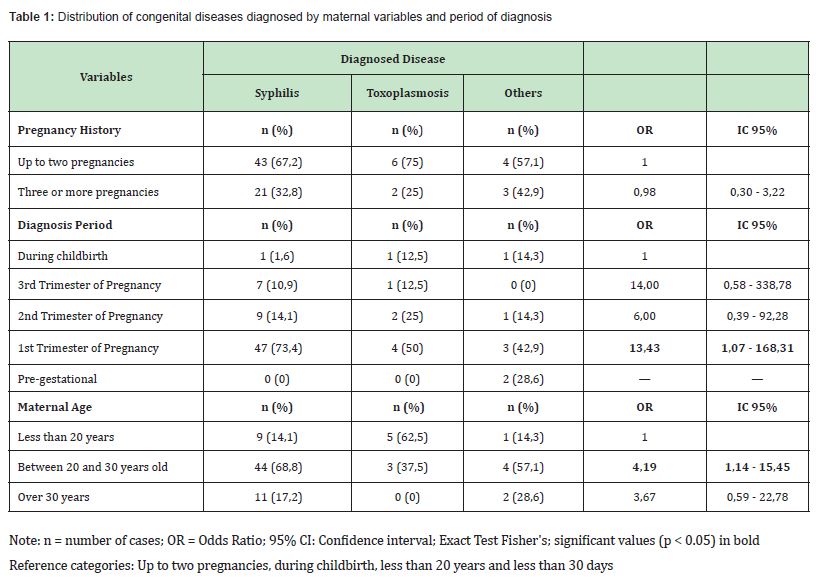
Statistical analysis revealed a significant association between maternal age and the presence of diagnosed disease [c²(4) = 9.23; p = 0.027; Cramer's V = 0.28]. The results indicate that women with maternal age between 20 and 30 years are 4.19 times more likely (95% CI: 1.14 - 15.45) to be diagnosed with syphilis compared to those with maternal age under 20 years. The Cramer’s V value (0.28) suggests a high-effect association between maternal age and diagnosed disease.
Fisher's exact test showed that there is no significant dependence between diagnosed disease and the pregnancy history variables [c² (2) = 0.64; p = 0.816].
On the other hand, the test revealed that the period of diagnosis has a strong association with the diagnosed disease [c² (8) = 17.21; p = 0.010; Cramer’s V= 0.42], showing that women who are in the first trimester of pregnancy are 13.43 times more likely (95% CI: 1.07 - 168.31) to be diagnosed with syphilis when compared to women during childbirth.
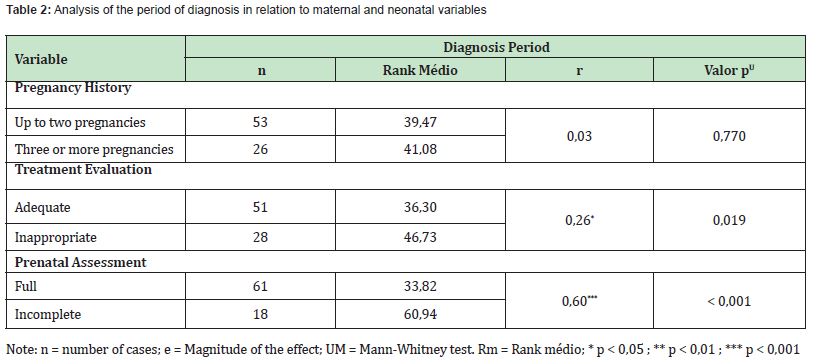
Table 2 presents a comparative analysis using the Mann-Whitney U Test of the variable Period of Diagnosis (pre-gestational, 1st trimester, 2nd trimester, 3rd trimester, during delivery) in relation to the qualitative variables Pregnancy History, Treatment Assessment, and Prenatal Assessment.
The results of this analysis indicate that the period of diagnosis does not differ significantly between women with up to two pregnancies and those with three or more pregnancies (U = 661; p = 0.770). The mean rank values were similar between the groups analyzed (Rm = 39.47 for up to two pregnancies and Rm = 41.08 for three or more pregnancies), suggesting a similar distribution of the diagnostic period between the pregnancy categories. The magnitude of the effect (r = 0.03) indicates an extremely small and statistically non-significant effect.
On the other hand, a significant and moderate difference was identified in the period of diagnosis between women who had complete prenatal care and those with incomplete prenatal care (U = 172; r = 0.60; p < 0.001). Specifically, women with incomplete prenatal care tend to have a later diagnosis (Rm =60.94) compared to women who completed prenatal care (Rm = 33.82).
Another relevant point is the statistically significant difference, although of small effect, found in the period of diagnosis between women who received adequate treatment and those who received treatment considered inadequate (U = 525.5; r = 0.26; p= 0.019). In this case, women with inadequate treatment tend to have a later diagnosis (Rm = 46.73) compared to women who received adequate treatment (Rm = 36.30), which may compromise the effectiveness of interventions.
Furthermore, the presence of a relationship between the treatment assessment and the variables prenatal assessment and child status was investigated, and the results obtained from this analysis are shown in Table 3.
Table 3 indicates a statistically significant association of small effect between prenatal assessment and treatment assessment [c²(1) = 4.12; p = 0.042; Phi = 0.23]. Women who completed prenatal care were 2.98 times more likely (95% CI: 1.01 - 8.79) to receive adequate treatment for congenital infections compared to those who did not complete prenatal care.
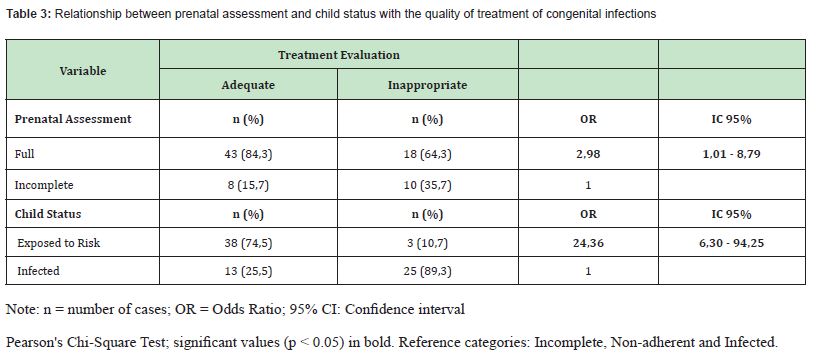
The analysis found a statistically significant and high-effect association between child status and treatment evaluation [c²(1) = 29.47; p < 0.001; Phi = 0.61]. Odds ratio (OR) analyses revealed that mothers receiving adequate treatment were 24.36 times more likely (95% CI: 6.30 - 94.25) to be exposed children when compared to infected children.
In this study, a predominance of cases of congenital syphilis was observed in southwest Goiás throughout the period investigated. Several factors may be correlated with this, including the underreporting of some diseases. According to the study by Nobre7 published in 2021 in São Paulo, congenital Chagas disease may be underestimated, due to the lack of serological screening in Brazilian regions and the possibility of the child being asymptomatic. Screening for cytomegalovirus (CMV) and rubella is no different, according to the Femina protocol, written by Bonomi, et al, screening for CMV is recommended only when suspected through symptoms or suggestive ultrasound findings and for rubella in case of susceptible women who wish to become pregnant.
In addition, the article by Costa8 published in 2024 adds reasons for the increasing cases of congenital syphilis, such as the mandatory reporting since 1986, the quality of the epidemiological information system, the possibility of early detection and the high coverage of primary health care. This, in addition to explaining the statistics, corroborates the fact that the disease is diagnosed 13.43 times in the first trimester.
The predominance in the age group between 20-30 years may be related to the most intense sexual phase, according to the study by Sousa from 2022. In turn, parity does not configure an important variable as a risk factor for congenital infections.
The predominance of diagnosis in the first trimester compared to delivery is correlated with syphilis screening. As the disease does not have immunity, it must be screened at 3 times: first trimester, 28 weeks and during delivery, thus providing a greater chance of early diagnosis.
Women who complete prenatal care tend to have earlier diagnoses of congenital infections compared to those who had incomplete prenatal care, highlighting the importance of rigorous and comprehensive prenatal monitoring for the early detection of these infections. And due to timely diagnosis, women with complete prenatal care have higher rates of appropriate treatment.
Identifying risks during prenatal care, delivery and newborn development is essential for a positive outcome for the newborn's health. To this end, the Ministry of Health created a classification of at-risk newborns based on low socioeconomic levels, such as living in a high-risk area, a history of death of children under 5 years of age in the family and teenage mothers.
Prematurity has multiple causes related to economic, physical and psychosocial factors associated with the mothers and families of the babies, making it even more difficult to estimate the real impact of prematurity.
The main social factors associated with prematurity are lack of access to or incomplete prenatal care. Teenage mothers under 16 years of age and with low socioeconomic conditions, such as the absence of a support network, have a direct increase in the risk of prematurity.
Adequate treatment of the mother is correlated with the exposed and uninfected child. This is because a mother who is treated properly reduces the chances of the fetus being infected transplacentally.
Prenatal care in the municipality of Southwest Goiás is 77.2%, which results in a cascade of positive results. These are the high rates of women with early diagnosis, adequate treatment and children only exposed to risk. Regarding epidemiology, the majority of mothers are between 20 and 30 years old and parity has no correlation with congenital infections.
None.
This Research Article received no external funding.
Regarding the publication of this article, the authors declare that they have no conflict of interest.
- 1. Moraes CL, Mendonça CR, Arruda JT, et al. Congenital infection-maternal-fetal diagnosis and treatment. Research, Society and Development. 2020;9(8):e137984965.
- 2. Bonomi Inessa BA, de Lacerda Lobato AC, Gabriele Silva C, et al. Rastreamento por exames laboratoriais em obstetrícia. Federação Brasileira das Associações de Ginecologia e Obstetrícia (Febrasgo), São Paulo. 2020;48(5):301-310.
- 3. Sociedade Brasileira de Pediatria. Tratado de Pediatria, 4 edição. São Paulo: Editora Manole Ltda. 2017.
- 4. Zhang L, Wang X, Liu M, et al. The epidemiology and disease burden of congenital TORCH infections among hospitalized children in China: A national cross-sectional study. PLoS Negl Trop Dis. 2022;16(10):e0010861.
- 5. Vieira RS. de infecções congênitas em recém-nascidos de mulheres infectadas pelo Zika Vírus. Programa de Pós-Graduação Stricto-Senso, Curso de Mestrado Profissional em Saúde da Criança e da Mulher. Rio de Janeiro. 2019;pp.1-110.
- 6. Barth FV, Polay JPG, Ost C. Epidemiological analysis of congenital syphilis in the State of Paraná, Brazil. Rev Assoc Med Bras (1992). 2024;70(4):e20231170.
- 7. Nobre T, Fonseca S, Medeiros R, et al. Seroprevalence of Trypanosoma cruzi in pregnant women in Midwest Brazil: an evaluation of congenital transmission. Rev Inst Med Trop Sao Paulo. 2021;29:63:e8.
- 8. Costa IB, Pimenta IDSF, Aiquoc KM, Oliveira ÂGRDC. Congenital syphilis, syphilis in pregnancy and prenatal care in Brazil: An ecological study. PLoS One. 2024;19(6):e0306120.
