

Hand conditions, including carpal tunnel syndrome (CTS), trigger finger (TF), De Quervain’s Tenosynovitis (DQT), and ganglion cysts, are common around the world, leading to functional impairment and reduced quality of life. Despite their prevalence, public awareness and knowledge of these conditions remain understudied in Saudi Arabia, particularly in urban populations such as Jeddah. This cross-sectional study assessed the prevalence, knowledge, and awareness of these common hand conditions among 313 participants in Jeddah from October 2023 to June 2024. Data were collected using a structured questionnaire and analyzed via SPSS version 26. Only 15% of the participants demonstrated a high level of awareness, while 85% had a poor understanding. CTS was the most recognized condition (38% awareness) and the most prevalent, affecting 6.7% of participants. TF (5.1%) and DQT (2.2%) followed in prevalence. Educational attainment significantly influenced awareness, with university graduates exhibiting higher levels of knowledge. Participants diagnosed with any hand condition also showed greater awareness. These findings emphasize the urgent need for public health initiatives focused on the prevention, early diagnosis, and management of hand conditions. Future studies should focus on developing tailored health care programs to improve knowledge and outcomes for these conditions in Saudi Arabia.
Keywords: Hand surgery, Awareness, Carpal tunnel syndrome, Trigger finger, De Quervain’s tenosynovitis, Saudi Arabia
The hands are considered the most advanced and unique musculoskeletal instrument in humans, and they are also the most helpful portion of the upper extremities.1 Hand conditions are a prevalent medical concern that impacts a substantial segment of the global populace.2 These ailments can range in severity from minor injuries to chronic conditions that significantly impact a person’s quality of life.2 The most common hand disorders are Trigger Finger, Carpal Tunnel Syndrome, De Quervain’s Tenosynovitis, and Ganglion Cysts.3
Globally, the most prevalent peripheral nerve entrapment syndrome is carpal tunnel syndrome (CTS). Carpal tunnel syndrome occurs due to pressure on the median nerve, which passes through a narrow region in the wrist known as the carpal tunnel.4 Although larger bones, thicker ligaments, or tendon sheaths can be to blame, the condition is mostly idiopathic. It results in hand numbness, pain, tingling, and weakness.4
Trigger finger (TF), or flexor tenosynovitis with tendon narrowing (stenosis), occurs when inflammation causes a size mismatch between the A1 pulley—positioned at the metacarpal head— and the flexor tendon or its sheath.5 TF is a widespread hand ailment that affects 2–3% of the population. Its frequency rises in the presence of concomitant disorders such as diabetes mallets (DM).5,6
The most typical soft-tissue swelling in the hands and wrists is a ganglion cyst.6 The dorsal side of the wrist accounts for 70% of cases, with the volar side accounting for 20% and the tendon sheath of the fingers following closely behind.7 Most ganglion cysts do not cause any symptoms, except for swelling.7 Most patients sought guidance and medical attention due to their ganglion’s physical look or out of concern that it was a cancerous tumor.7
Treatment is not usually necessary for these benign lesions.8 Patients should only receive treatment if they exhibit symptoms; otherwise, there is a chance of recurrence. Patients who show no symptoms can be monitored. Most patients have a favorable prognosis.9,10
De Quervain’s tenosynovitis (DQT) syndrome, sometimes referred to as “mother’s thumb” or “gamer’s thumb,” is a standard wrist pathology.11 The thickening of the synovial sheath containing the tendons of the extensor pollicis brevis (EPB) and abductor pollicis longus (APL) likely causes the condition. which irritates the muscles, Pain and swelling on the radial side of the wrist, and difficulty gripping objects.11,12
The hands are more susceptible to fractures than other body parts. They account for about 20% of all fractures and 40% of fractures involving the upper limb.3,13 The underlying reasons for these injuries differ significantly based on demographic traits.13,14 Healthcare providers can typically manage most hand fractures conservatively, but others need to be surgically repaired.3 A previous study in Al Majmaah city found that adults had a strong awareness of community health issues.15 Notably, the prevalence of CTS is 14%.15 However, research on the prevalence and awareness of hand diseases in Saudi Arabia remains limited.
This study examined the prevalence, knowledge, and awareness of hand conditions among the general population of Jeddah, Saudi Arabia.
Study Design, Location, and Time
This cross-sectional, descriptive study was conducted in Jeddah, Saudi Arabia, from October 1, 2023, to June 1, 2024, as part of an awareness-raising campaign.
Study subjects
Inclusion Criteria: Adult individuals from the Saudi general population in the selected study area who had consented to participate.Exclusion Criteria: Individuals unable or unwilling to provide informed consent or complete the questionnaire, children under 18 years, and people with cognitive impairments or language barriers.
Sample size
The sample size was calculated using the Raosoft online calculator, with a 5% margin of error and a 95% confidence level, resulting in a minimum required sample size of 300 participants.
Study instrument
We designed a questionnaire to collect demographic data (age, gender, occupation) and assess participants’ knowledge of common hand conditions, including CTS, TF, ganglion cysts, and DQT syndrome. Participants also reported their knowledge of hand-fracture management.
Data collection
Participants were recruited during a hand-condition awareness-raising campaign in Jeddah (May 2024). The validated questionnaire, adapted from previous studies,16,17 included demographic questions and assessed awareness of hand conditions. We scored each correct response as 1, while incorrect or “do not know” responses were scored as 0. Bloom’s criteria were used to classify knowledge: ≥80% of correct responses indicated good knowledge, while <80% indicated poor knowledge.
The questions assessing the participants’ knowledge of common hand conditions were as follows:1. Have you heard of carpal tunnel syndrome?
2. Have you heard of trigger finger?
3. Have you heard of ganglion cysts?
4. Have you heard of De Quervain’s syndrome?
5. Do you know how hand fractures treated?
Questionnaire Validation
The questionnaire’s content validity was assessed by three experts, yielding a content validity index of 91.6%, indicating excellent relevance.
Reliability analysis
The internal consistency of the questionnaire was assessed using Cronbach’s alpha, yielding a value of 0.88, indicating excellent reliability.
Data analysis
The data were analysed using SPSS version 26. Chi-squared tests (χ2) were applied to examine the associations between variables. Descriptive statistics were used for demographic data, and significance was set at p < 0.05.
Ethics
Ethical approval for the study was obtained from the research ethics committee of King Abdulaziz University, Jeddah, Saudi Arabia.
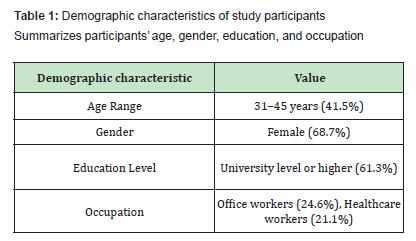
The study included a total of 313 participants. Of these, 41.5% were aged 31–45 years, 68.7% were female, and 61.3% had a university-level education. In addition, 24.6% were office workers, while 21.1% were employed in the healthcare field Table 1.
Carpal Tunnel Syndrome (CTS)
Over a third (38%) of participants reported awareness of CTS. Among those familiar with the condition, the most commonly reported symptoms were pain (75.6%) and numbness (74.7%). The primary risk factors were repetitive hand use (55.4%) and diabetes mellitus (36.9%). Most participants (62.6%) identified surgery as the management method, and 17% had previously been diagnosed with CTS.
Trigger Finger (TF)
Awareness of TF was reported by 29.1% of participants. The most common symptoms reported by those aware of TF were finger locking or catching (83.5%) and pain (36.2%). Repetitive hand use (58.2%) and diabetes mellitus (39.5%) were the primary risk factors, with 58.4% of participants mentioning surgery as the management approach. Approximately 17.6% of those aware of TF had a previous diagnosis.
Ganglion Cyst
Almost a third (32.6%) of participants knew ganglion cysts. The most frequently reported symptoms were swelling or cyst formation (91.1%) and reduced range of motion in the wrist (43.1%). Repetitive hand use (47%) and unknown causes (33.3%) were the most cited risk factors. 56.8% of participants aware of the condition identified surgery as the treatment method.
De Quervain’s Tenosynovitis (DQT)
Just over a fifth (21.7%) of the participants were aware of DQT. The primary symptoms identified by participants were pain (80.8%) and decreased wrist range of motion (67.6%). Repetitive hand use (70.5%) was the leading risk factor, and 48.5% cited surgery as the treatment option.
Prevalence of hand conditions
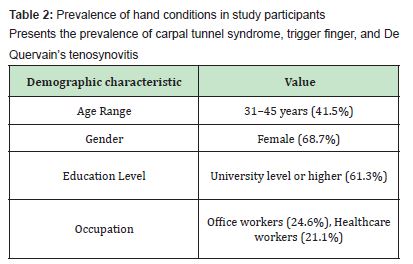
The prevalence rates for common hand conditions in the study sample were as follows: CTS (6.7%), TF (5.1%), and DQT (2.2%) Table 2.
Knowledge level
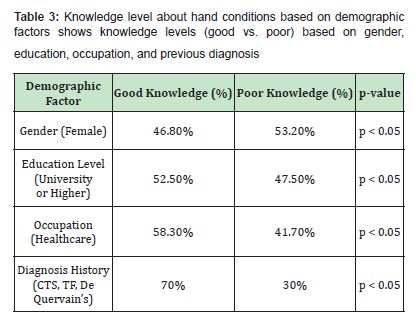
The mean knowledge score across all participants was 3.99 ± 2.13. Fifteen percent of participants demonstrated a good level of knowledge regarding hand conditions, while 85% exhibited poor knowledge (Table 3). Knowledge levels were significantly higher among female participants, individuals with university-level education, and those in healthcare (p < 0.05). Participants with a prior diagnosis of hand conditions demonstrated significantly higher knowledge levels than those without any diagnosis (p < 0.05; Table 3).
Statistical analysis
A chi-square test was used to assess the associations between demographic factors (gender, education level, occupation) and knowledge levels. The results revealed a statistically significant association between these factors (p < 0.05).
CTS is primarily caused by repetitive motion and wrist strain, leading to significant medical costs, lost productivity, and a heavy financial burden on society.12 As the condition progresses, individuals may experience hand weakness, diminished fine motor coordination, clumsiness, and eventual atrophy of the thenar muscles.12 A comprehensive understanding of CTS is crucial for accurate diagnosis and treatment. This requires a thorough patient assessment, including physical examinations, patient histories, and electrophysiological diagnostic tests, while ensuring a balance between accuracy and avoiding unnecessary tests.12 Treatment should be individualized based on the underlying cause and severity of the condition.12 In our study, CTS was the most common hand condition, with an incidence rate of 6.7%. This rate is higher than the prevalence documented in Western populations, where CTS is typically reported to affect 4–5% of the general population.17 Previous studies conducted in Saudi Arabia show variable CTS prevalence, with Alyousef reporting 14% in Majmaah City,11 Altraifi finding 24.1% in Hail City,18 and Alamir documenting 12% in Riyadh.19 The frequency of CTS in our study is higher than that reported by Tawakul20 and Mirghani21 in Tabuk City, Saudi Arabia, where the prevalence was 2.4% and 3.4%, respectively.
DQT syndrome, caused by inflammation of the tendons near the base of the thumb, was found in 2.2% of our participants. This condition is often triggered by prolonged overuse of the tendons that connect the EPB and APL muscles.15 TF was reported as the second most common hand condition, with a prevalence of 5.1%. Research shows that 2–3% of the general population suffers from TF, with the prevalence rising to 5% to 20% in individuals with diabetes mellitus.22,23 Our study revealed moderate awareness of hand conditions, with 38% of participants aware of CTS, compared to 25.2% in Al-Jouf Region, Saudi Arabia,24 and 39.9–58.7% in the western part of Saudi Arabia, including cities such as Makkah, Medina, Jeddah, and Taif.18
Education was strongly associated with awareness, with individuals having higher educational attainment showing a better understanding of CTS and other hand conditions (p<0.001).
In conclusion, while our study highlights a high prevalence of hand conditions such as CTS, TF, and DQT, it also identifies significant gaps in public awareness and knowledge. These findings emphasize the importance of targeted health education campaigns to enhance early detection and management of hand conditions, especially within the Saudi population. However, the cross- sectional design of the study limits the ability to establish causality, and the self-reported nature of the data may have introduced bias. Future research should include longitudinal studies and validate the findings with clinical diagnoses to clarify the true burden of these conditions.
Strengths of the study
A considerable strength of the present study was its inclusion of a large sample size from the general Saudi population. In addition, this is one of the few studies conducted in the kingdom to explore hand-disease prevalence and awareness.
Limitations
A limitation of the current study was its use of a self-reported questionnaire that couldhave introduced a recall bias. Another limitation was the use of a cross-sectional study design, able to reveal associations between variables and not casual relationships. Another limitation was the collection of data from a campaign that does not cover a wide area of Jeddah, as this could hinder the generalization of the strutting results.
Our results reveal several gaps in public awareness of common hand conditions in Jeddah, Saudi Arabia. Although CTS awareness levels were moderate, further questioning revealed inadequate knowledge about the symptoms and treatment options. Our findings highlight the need for health promotion and awareness programs targeting common hand conditions to improve public understanding and promote early detection and intervention.
Furthermore, healthcare practitioners should integrate patient education into daily clinical practice, especially for high-risk groups. Additional studies are required to evaluate the effectiveness of educational interventions and develop efficient strategies for promoting hand health nationwide.
We would like to thank the participants who took part in this study and made this research possible. We also acknowledge the support provided by the Faculty of Medicine at King Abdulaziz University, Jeddah, Saudi Arabia. This research was conducted in compliance with ethical standards, and ethical approval was obtained from the Institutional Review Board of King Abdul Aziz University, Jeddah, Saudi Arabia (Approval No. [Reference No 498-23]). Informed consent was obtained from all study participants. The authors declare that they received funding for this research from the Deanship of Scientific Research at King Abdulaziz University, Grant Number (GPIP: 1455-828-2024). The authors also declare no conflicts of interest related to this study.
The authors declare that they received funding for this research from the Deanship of Scientific Research at King Abdulaziz University, Grant Number (GPIP: 1455-828-2024).
The authors also declare no conflicts of interest related to this study.
