

During Lyophilization we observed many changes in Glass vials like strain and breakage caused by the thermal expansion and contraction of the frozen solution, because of crystallization of excipients occurs during thawing. Also fogging or bubbling on the internal surface of the glass vials from poor wettability and solution splashing, surface defects or uneven thickness due to manufacturing defects such as molding.
- Strain and breakage: The most significant change is the physical stress on the vial.
- Thermal contraction: During the freezing phase, the solution contracts, creating negative strain on the vial.
- Thermal expansion: During the warming/thawing phase, the ice and any crystallized excipients (like mannitol) expand, driving the strain to positive values and potentially leading to vial breakage.
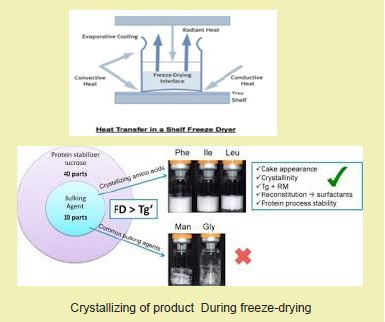
- Crystallization: Excipients such as mannitol can crystallize during freezing and/or thawing, and this rapid volume expansion puts additional stress on the vial.
- Surface issues: The internal and external surfaces of the vials can be affected.
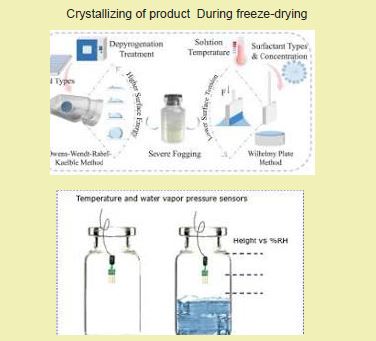
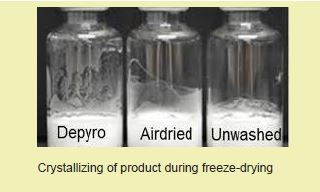
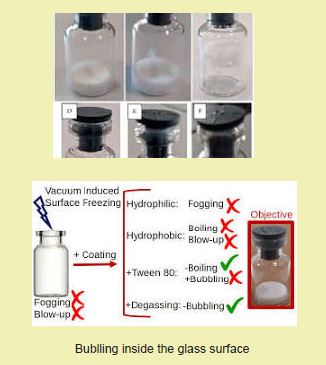
- Fogging: Water-repellent (hydrophobic) vials may show fogging or white veil formation.
- Solution creeping: On hydrophilic vials, solution may creep up the walls, which can be a problem if the inner wall is not clean.
- Bubbling/Defects: Hydrophobic surfaces can prevent proper wetting and lead to bubbles forming during the process.
- Manufacturing-related changes: The manufacturing process itself can cause changes in the glass.
- Vial thickness: Molding processes create vials with more uniform wall thickness compared to tubing vials.
- Mechanical strength: Aluminosilicate Glass vials have greater mechanical strength and break in a more controlled way.
- 1. Use “Blow back glass vial and blow back rubber stopper.” Prevents popping during Lyophilization and stoppering.
- 2. Choose user-friendly, innovative packaging materials.
- 3. Ensure primary packaging material compatibility with the product.
- 4. Use “Moulded Vial” with flat bottom to avoid uneven heat distribution.
- 5. Dual chamber systems present challenges in heat flow and configuration compared to standard vials.
- 6. Dual chamber packaging improves patient convenience and safety.
None.
This Short Communication received no external funding.
The author declares no conflict of interest regarding this publication.
