

Introduction: Treatment for bone injury in children is different to adult. Selecting method depeding on age, articular cartilage and demanding movement. Non-operation treatment on direction and immobilization in plaster is academic method, good result, aspecialy in little children.
Case report: A man 4 years old who has bihumerus fracture and bifemur fracture in multiple injuries condition was directtioned and immobilizationed in plaster at Orthopeadic clinical and out patient department- Viet Duc University Hospital.
Result: Affter 1 year, patient has good result, good bone regeneration, good direction, balance limb height, patient movement is normaly without complication. Conclustion: direction and immobilization treatment are a good choice for bone injury in little children.
Keywords: Bone injury, Little children, Immobilization
Children are not miniature adults. Children and adults have similarities and differences in the musculoskeletal system, so in the treatment of fractures in children and adults, we need to clearly understand the differences to have the most appropriate treatment direction for each subject, each age group to have the best treatment effect. The younger the child, the faster the bone development occurs, this development is mainly due to the development and ossification of the epiphyseal cartilage. Fractures in children are mainly greenstick fractures, the time to heal the bone is also shorter than in adults, so the indication for non-surgery treatment in children's fractures is always given priority.
As society develops, injuries caused by traffic accidents also occur more and more in number with increasingly serious and complex nature. Children are not an exception to this general rule of society. Treatment of fractures in children has always been a priority, however, in terms of indications for conservative or surgical treatment, it is still not really clear, especially in cases of multiple injuries, diverse and complex injuries as well as the rapid development of surgical means of bone fusion.
At the Department of Trauma Examination and Outpatient Treatment of Viet Duc University Hospital, we treated a 5-year-old male patient with multiple injuries including fractures of both humerus and both femurs combined with abdominal and chest trauma. After treatment, the patient recovered very well in terms of both bone anatomy and motor function.1-7
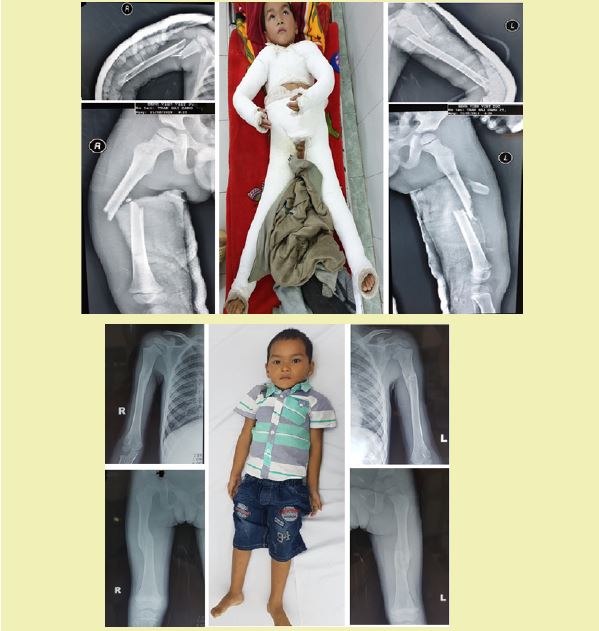
5-year-old male patient, patient after a motorbike-car accident, he was carried on the back of his father's motorbike. After the accident, he was brought to the hospital in a state of multiple trauma, cranial and subarachnoid hemorrhage, rib fractures, closed abdominal trauma: grade III liver injury, grade II spleen injury. Regarding orthopedic trauma, there were closed fractures of the femur shaft on both sides, closed fractures of the humerus shaft on both sides, no accompanying vascular and nerve injuries. The patient was consulted with the participation of doctors specializing in neurology - cranial, cardiothoracic, digestive and orthopedic trauma. Regarding cranial trauma, chest trauma and abdominal trauma, the child was indicated for conservative treatment combined with orthopedic trauma, the patient was given a cast for both thighs and shins to prevent rotation and a cast for both forearms and hands. The patient was treated at the Department of Pediatric and Neonatal Surgery with antibiotics to prevent infection, fluid and blood replacement, and physical improvement. After 2 weeks of treatment, the patient's chest and abdomen were stable, the patient's physical condition improved significantly, the patient was adjusted, and casts were replaced on both chest, shoulder, and arm and both pelvis, back, and legs.
4 weeks after the cast was changed, the patient was re-examined, the cast was removed, and an X-ray showed that the bone had healed well. The patient's cast was removed and the family was instructed in exercises to soften the joint, from non-weight bearing to gradually increasing weight bearing.
After 3 months of intensive treatment, the hospital and family worked together to help the patient recover very well. The patient was able to go to the clinic by himself without the need for crutches or a wheelchair. The patient's movement was checked and the motor function of his arms and legs had almost completely recovered. X-rays showed that the bones were strong see figures.
Follow-up
The patient was re-examined periodically once a month for the first 3 months, and once every 3 months for the next 9 months. Currently, 1 year after the accident, the patient has returned to normal activities, has returned to school, and can perform personal activities. The patient can start playing light sports without resistance, and the range of motion of the upper and lower limbs is not limited. Through examination and measurement, it was found that the 2 arms are of equal length, the 2 lower limbs are of equal length, and the axes of the upper and lower limbs are straight. X-ray examination showed that the calves are good, the calves are stable, and there is no axis deformity or poor bone healing. The patient's family is very satisfied because the patient has recovered very well, avoiding complicated surgery, the patient is cheerful and sociable without many scars on the body.
Fractures in children have always been a challenge in the treatment of orthopedic fractures. Children have a great need for movement, rapid bone growth, but children have a great ability to self-adjust. According to the classic pediatric treatment, conservative treatment is always the top priority, however, society is increasingly developing, children grow rapidly, patients aged 8-15 years old even have body size and weight close to adults, causing many difficulties in choosing treatment methods.
Society is increasingly developing, the fast-paced lifestyle leads to the increase of means of transport, especially motorbikes, so traffic-related injuries are also increasing. Children are no exception to that trend, however, because the musculoskeletal system is not fully developed, in traffic accidents, children often suffer more serious injuries, multiple injuries, traumatic brain injuries, chest and abdominal injuries. Children's fractures due to traffic accidents often have multiple fractures, complex fractures, and even open fractures. The treatment of fractures in cases of multiple trauma requires the coordination of many specialists, and requires an explanation to the family about the value, benefits and risks of treatment methods. Bone fusion surgery is a very good treatment method when it can bring the bone to the best anatomy as well as firmly fuse the bone, but it is always necessary to consider when the patient has not fully ossified the epiphyseal cartilage as well as the risk of blood loss in cases of multiple trauma.
Conservative treatment has been known for a long time, before the classical surgical methods and is still valuable today. Bone manipulation and plaster casting are preferred for children due to their ability to limit the impact on growth cartilage, affecting the axis as well as the length of the limb. Bone manipulation under anesthesia and X-ray examination allows intervention in most cases of pediatric fractures, helping to achieve good correction results both on X-ray films and on the limb axis and function, while having little effect on bone and cartilage development. The strong development of modern bone fusion tools has greatly reduced the indications for conservative treatment - bone manipulation and plaster casting - but cannot completely replace this classical method. Bone manipulation and plaster casting have no incisions, no scars, no blood loss, low risk of infection, no bone fusion devices, no impact on the periosteum, bone development are benefits that no other bone fusion surgery method can compare to.
Conservative treatment by bone manipulation and plaster casting has existed for a long time and has also developed in depth and modernized with the development of medicine in our country as well as in the world. Currently, at the Department of Trauma Examination and Outpatient Treatment of Viet Duc Friendship Hospital, bone manipulation and plaster casting under fluorescent screens with the support of anesthesia and a team of highly skilled technicians, enthusiastic in their work has greatly improved the quality of bone manipulation and plaster casting. In the case of the above patient, after the adjustment, the bones had enough length, minimizing lateral displacement, the limb axis was straight, and the limbs were balanced. Then, along with the development of the bones with very good self-adjustment in children, the broken bones healed and developed well, the function and activity of the limbs returned to almost normal.
Any treatment method, no matter how modern or advanced, cannot completely avoid possible complications or accidents. Children are a very sensitive group of patients due to their poor resistance as well as the ability to affect the long-term development of the body later on. Limiting direct impacts on bones, periosteum or epiphyseal cartilage as well as interventions with the risk of infection will minimize the risks that may affect the physical and psychological development of children later on. Conservative treatment by bone manipulation with careful care before, during and after manipulation has limited adverse effects on the development of children as well as minimized possible complications. In this case, the patient was manipulated effectively and without any complications.
Children's fractures are a very special part of orthopedic trauma that needs attention in choosing the most optimal treatment method. The choice of treatment method depends on age, bone and epiphyseal ossification, movement and learning needs, as well as associated injuries. Evaluating the results of surgical or non-surgical treatment of pediatric fractures requires long-term studies with a large number of patients, as well as many complex comparison aspects. Conservative treatment by manipulation and plastering is a classic method, which has been improved and modernized, bringing good treatment results in both anatomy and function, especially in children who have not yet gone to school with minimal complications. Conservative treatment is a very good choice for treating pediatric fractures that orthopedic trauma doctors consider when examining and treating.
None.
This Case Report received no external funding.
Regarding the publication of this article, the author declares that he has no conflicts of interest.
- 1. Lã Ngọc Qúy, Hoàng Ngọc Sơn. Điều trị gãy xương ở trẻ em. Nhà xuất bản Y học. 2011.
- 2. Đình Toàn D, Quốc Hưng V, Trọng Tài N. Đánh Giá Kết Quả Điều Trị Bảo Tồn Gãy Kín Thân Xương Đùi Trẻ Em Tại Bệnh Viện Hn Việt Đức. Tạp Chí Y học Việt Nam. 2022;508(2).
- 3. Bùi Bích Vượng, Phạm Văn Tuấn và cộng sự. Nhận xét kết quả điều trị bảo tồn gãy xương đùi ở trẻ em (tại khoa khám xương và điều trị ngoại trú bệnh viện Việt Đức). Kỷ yếu Hội nghị khoa học thường niên viện chấn thương chỉnh hình lần thứ 3, tháng 10/2014 presented at the: Bệnh viện Hữu nghị Việt Đức. 2014.
- 4. Szostakowski B, Smitham P, Khan WS. Plaster of Paris-Short History of Casting and Injured Limb Immobilzation. Open Orthop J. 2017;11:291-296.
- 5. Joeris A, Lutz N, Wicki B, et al. An epidemiological evaluation of pediatric long bone fractures - a retrospective cohort study of 2716 patients from two Swiss tertiary pediatric hospitals. BMC Pediatr. 2014;14:314.
- 6. Weber B, Kalbitz M, Baur M, et al. Lower Leg Fractures in Children and Adolescents-Comparison of Conservative vs. ECMES Treatment. Front Pediatr. 2021;9:597870.
- 7. Tong L, Pooranawattanakul S, Gopal Kothandapani JS, et al. Comparison of prevalence and characteristics of fractures in term and preterm infants in the first 3 years of life. Pediatr Radiol. 2021;51(1):86-93.
