

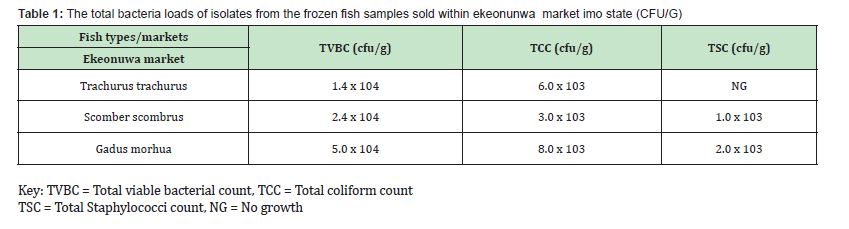
Fish contains large population of protein and is valuable body building fluid. It contains considerable amounts of Vitamin B, vitamin E, nutrients like niacin and minerals such as copper, iodine, iron and phosphorous hence, there is increasing demand for fish in Nigeria and there is a large deficit between the demand and supply of fish which is augmented by massive importation of frozen fish. However, fish from natural environments, are known to harbor various bacterial species and bacterial colonies which may be observed on the skin and gills due to a constant exposure to contaminated water. Spoilage of fresh and highly preserved fish products are mostly caused by microbial actions and extensive handling are opportunities for other food borne pathogens to contaminate products. This research was therefore aimed at determining the microbial load of three fish species sold at Ekeonunwa market in Owerri, Imo state Nigeria. The fish species which are Scomber scumbrus, Trachurus trachurus and Gadus morhua, were analyzed for total viable bacterial count, total coliform count, total Staphilococal count, biochemical characteristics and carbohydrate fermentation of bacterial isolates, frequency and percentage occurrence of the bacterial isolates as well as the antibiotic susceptibility patterns of the bacterial isolates. The result of the total bacterial loads of the isolates show that there was no growth of TSC on Trachurus trachurus, while TVBC and TCC, were 1.4×10⁴ and 6.0×10³ respectively. That of Scomber scumbrus gave 2.4104, 3.0103 and 1.0×10³ for TVBC, TCC and TSC respectively while Gadus mohua gave 5.0×10⁴, 8.0×10³ and 2.0×10³ for TVBC, TCC and TSC respectively. The antibiotic succeptibility test for the bacterial isolates, shows that the different bacterial species which are Bacillus spp, Satphilosocus spp, Enterococcus spp, Eschericcia coli, Shigella spp, Pseudomonas spp and Salmonella spp, were inhibited at different zones and levels to the different antibiotics tested with those on the susceptibility level of 16mm and above, more predominant. From the results of the above research, good handling practices of fish on board, is encouraged as it helps the fish caught, remain in good condition and bad practices of keeping the catch on floor of the beach, should be discouraged while a raised area such as a table or concrete slab for keeping the fish and maintenance of good quality in our local markets, should be encouraged.
Keywords: Scomber scumbrus, Trachurus trachurus, Gadus morhua, TVBC, TCC, TSC, Biochemical characteristics, Carbohydrate fermentation, Bacterial isolates, Antibiotic
Fishes are widely consumed in many parts of the world by humans due to their high protein content, low saturated and significant omega-3 fatty acid known to support good health.1 Nearly everything that can be found on land eventually makes its way to a stream. This is because every bit of ground or earth is a part of some rivers water shed.2 The contamination of freshwater with a wide range of heavy metals has become a matter of urgent concern over the past decades. Fish are often at the top of aquatic food chain and when pollutants build up in the food chain, fish are widely used to evaluate the health of aquatic ecosystems. Fish may concentrate large amounts of metals from the water and therefore are responsible for adverse effects and death in the aquatic systems.3,4 The threat of toxic and trace metals in the environment is more serious than those of other pollutants due to their non-bio-degradable nature, accumulative properties and long biological half-lives. It is difficult to remove them completely from the environment once they enter into it.5 Fishes are also richest sources of Omega-3 fatty acid, polyunsaturated fatty acids.6 Many studies have shown that eicosapentaenoic acid (EPA or 20 Omega-3 fatty acid) and docosahexaenoic acid (DHA or 22:6 Omega-3 fatty acids) are present and in important amounts in fish tissues.7 Minerals play an important role in maintaining body functions because they maintain acid-base balance and help in blood formation (hemoglobin formation).8 There is increasing awareness of the potential hazards that exist due to the contamination of fresh water especially by heavy metals or toxins associated with mining, industrial and agricultural practices.9,10 Due to their roles in bioaccumulation process, fish tissues like the muscle, liver and gills are frequently used for analysis.11 Fish contains a large proportion of protein therefore is a valuable body building food. Fish is an important source of complete protein; it is fresh and tender due to its bundle of muscle fibers which are tight together by fibrous materials largely made up of a protein called collagen, therefore an excellent dish for the old and diabetic patients. Fish also contains considerable amounts of vitamin B, Vitamin E nutrients like niacin and minerals such as copper, iodine, iron, and phosphorus. Canned salmon and sardines are good sources of calcium. Fish makes a vital contribution to survival and health of a significant portion of the world’s population. Fish from natural Environments are known to harbour various bacterial species.12 Bacterial colonization can be observed on fish skin and gills due to constant exposure to contaminated water, while the digestive tract may be affected through contaminated feed or water. Contamination of fish muscles is also possible when immunology existence is compromised.13
However, spoilage of fresh and highly preserved fish products is mostly caused by microbial action.14 Extensive handlings provide opportunities for the other food borne pathogens to contaminate products if sufficient attention is not given during freezing process.15
In addition, they can also function as carriers of several microbial and other health hazards.16 Therefore, maintenance of quality is of utmost importance in production and trade of fishing products. Most of current quality control techniques are time consuming and cumbersome. Although only a few infectious agents in fish are able to infect humans, which can result to fatalities. However, the greatest risk to human health is due to the consumption of raw or insufficiently processed fish and fish products 16. According to the center for food safety and applied Nutrition in Washington,17 most fish related food borne illness are traced to Salmonella, Staphylococcus spp, Escherichia app ,Vibrioparahemolyticus, Clostridium peringens, Clostridium botulinum E, and Enteroviruses. Microorganisms are found mostly on the skin, gills, operculum and intestines of live and newly caught fish. The microbial loads vary enormously in the different parts of the fishes and reported the normal range of 10-2-10-7 on skin surfaces. Fish contamination can also be linked to raw material, personnel, processing tools such as forklifts through leakage, opening in building and pests. Some pathogens may even become established in the processing plants from niches where they can survive for a long period of time. The quality of our fish is of major concern to the food processors, consumers and public health authorities and provisions of safe, wholesome and acceptable fish and its product as food to consumers and control of microorganisms is essential to meet these objectives. Fish is a very perishable food being highly susceptible to oxidation and microbiological deterioration. Therefore, efficient storage strategies need to be employed in order to increase its shelf - life and guarantee its safety and quality from catch to consumption. The shelf - life of fish is dependent on several factors such as storage, time, temperature, fish species, the stress suffered during catch and the amount of ice.18
Fish is an important food commodity in the international trade but they deteriorate rapidly especially when storage facilities are lacking.19Fish are highly perishable and prone to vast variations in quality due to differences in species, environmental habitats, feeding habits and antibiotic treatment (usage) in fish production.
Sample location
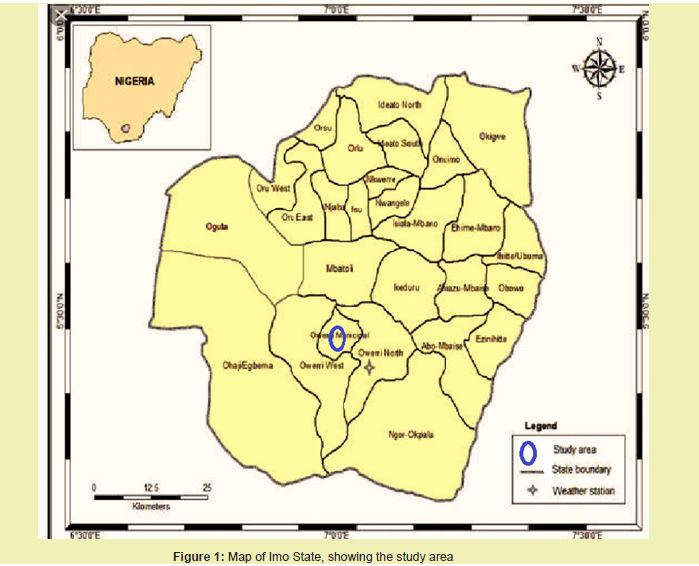
See Figure 1.
Sample collection
Three species of marine fishes most commonly sold within Imo State were randomly selected for the study. These include; Scomber scumbrus, Trachurus trachurus and Gadus morhua thesewere purchased from, Ekeonuwa market in Imo State with coordinates (5.48310 o N, 7.03249 o E),. The fishes were taken to the Department of Fisheries Technology Federal Polytechnic Nekede Owerri, Imo State for proper identification.
Sample preparation
The fish samples were transported in an icebox to the laboratory. Each of the fishes was weighed and the total length taken before the cleaning and dissection began. The fish samples were thoroughly cleaned and then dissected with a clean stainless steel knife. The muscles were separated from each sampled specie and labeled accordingly. The separated fish organs were oven dried at 1050C for 12hrs and ground into powdered form using an electrical grinder. The oven-dried samples were packed in an air tight container, labeled and stored in a desiccator until ready for use in subsequent chemical analysis which was in triplicate.
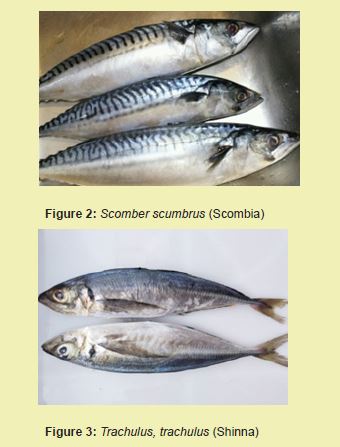
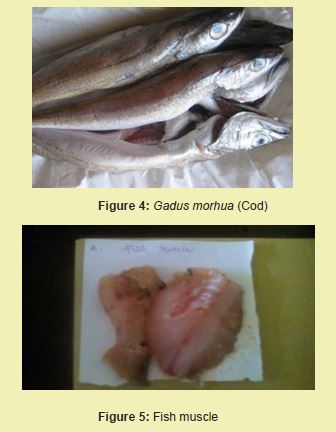
The different fish species used for study
See Figures 2-5.
Bactriological analysis of samples
With the aid of a sterile knife, cuts were made on the edible parts of the fish samples and homogenized and about 10g taken for microbiology analysis. Sample from different locations of the fish skin were taken by rubbing the sterilized cotton swab over the skin and then inoculating into the nutrient and MacConkey broth. The samples were labeled before taking to the laboratory for analysis.
Sterilization of materials
The method described by Pirker20 was adopted in the sterilization of the materials. All the glassware to be used in this study were sterilized using laboratory hot air oven at temperature of 1600C for 1hour and media used in this study were sterilized using the autoclave at a temperature of 1210C at 15psi for 15 minutes. After the sterilization, the media (nutrient agar, Mannitol salt agar, eosin methylene blue agar) were brought out together with the glassware and kept on a clean laboratory bench. The media were poured into the Petri dishes when cooled to 450C and allowed to solidify.
Isolation of bacteria from the frozen fish samples
The method described by Ekanem and Udoma21 was adopted in the isolation of microorganisms from the frozen fish samples. Swabs from sampled surfaces were inoculated in 10ml of peptone water by cutting the swabs aseptically into the peptone water, shaking and was allowed to stand for 20 minutes. The spread plate technique as was used in the inoculation of the plates. 0.1 milliliter aliquot and was dropped onto the different media in the plates. A sterile bent glass rod was used to spread the aliquot evenly on the media (nutrient agar, Mannitol salt agar, eosin methylene blue agar). The plates were labeled accordingly. The inoculated plates were inverted and incubated in the incubator at a temperature of 370C for 24 hours except sabouraud dextrose agar plates were incubated at room temperature (280C) for three days.
Microbial plate count
The method described by Ekanem and Udoma21 was adopted in the determination of the microbial plate count. After the incubation of the different plates, the different colonies formed on the media were counted using the digital colony counter. The total populations of the colonies were expressed as colony forming unit per gram (cfu/g).
Colonial morphology identification
The method described by Ekanem and Udoma21 was adopted in the colonial morphology identification. Presumptive identification of the colonies was done by observing their individual shape, colour, elevation, edge, surface, consistency and appearance on the media used for isolation. Colonies with characteristic metallic sheen on EMB agar and lactose fermenters on MacConkey agar were noted. The colonies were preserved in sterile agar slants in test tubes. Purified colonies were further characterized using Gram stain and biochemical tests.
Purification and preservation of isolates
Bacterial isolates were picked up with a sterile wire loop based on their morphological appearances. The picked colonies were sub cultured onto freshly prepared nutrient agar plates to obtain pure cultures. They were further incubated for 24h at 370C. After incubation, pure cultures were stored in McCartney bottle in a refrigerator at 40C.
Gram staining
The Gram staining technique described by Nur22 was adopted. A smear of each of the bacterial isolates was made and fixed by air drying. The smears were then covered with crystal violet stain for 60 seconds and rapidly washed off with water thereafter. The smears were then covered with Lugol’s iodine for 60 seconds and washed off with water. The smears were decolorized with acetone alcohol and washed off after 10 seconds. The smears were finally flooded with safranin for 2 minutes and washed- off with clean water. The back of the slides was then wiped and placed in a draining rack for the smear to dry before they were viewed with x 40 and x 100 oil immersion objective lens. Gram positive bacteria gave purple coloration while gram negative bacteria gave pinkish coloration.
Biochemical tests with the bacterial isolates
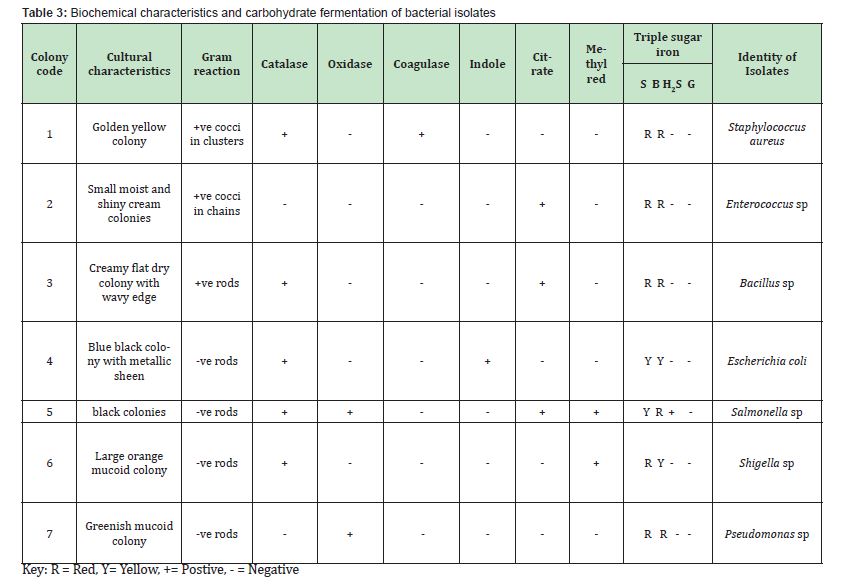
The method described by Nur22 was adopted in the biochemical characterization of the bacterial isolates. The biochemical tests carried out included; catalase, oxidase, coagulase, citrate utilization, indole production, sugar fermentation and motility test.
Motility test
The semi-solid agar of nutrient agar was used for this study. The media was prepared in slants and the organisms were inoculated by stabbing technique. Zig-zag growth along the line of stabs indicated a positive result while none indicated a negative result.23
Catalase test
This test is used to differentiate those bacteria that produce the enzyme catalase such as staphylococci from non-catalase producing bacteria such as streptococci. About 5 ml of hydrogen peroxide was poured into a tube and a sterile glass rod was used to collect a colony of the pure culture from the agar slant tube. It was dipped into the tube containing the hydrogen peroxide. Active bubbling indicated positive catalase test while none indicated catalase negative test.23
Indole Test
The test organisms were suspended in sterile peptone (about 3ml) preparation in sterile test. Tubes and incubated at 37°C for 48 hours after which 0.5 ml of Kovac’s reagent was added and shaken gently. A red coloration in the surface layer within 10 minutes was an indication of a positive test while none was an indication of a negative test.23
Oxidase test
The method of Cheesbrough23 was adopted for this test. A piece of filter paper was placed in a clean Petri-dish and three drops of fleshly prepared oxidase reagent was added in each case of the test organism. With a sterile piece of stick, each colony of the test organism was removed and smeared on each oxidase reagent drop on the filter paper. The development of a blue-purple coloration was an indication of a positive test while none was an indication of a negative test.
Coagulase test
A drop of distilled water was placed on each end of a slide for each of the test organisms. Thereafter a colony of each of the test organism was emulsified in each of the drops to make two thick suspensions. A loopful of plasma was then-added to one of the suspension and mixed gently for each of the test organism. Clumping within 10 seconds was an indication of positive test while none was an indication of a negative test.23
Sugar fermentation test
Each colony of the different test organisms were inoculated onto sterile agar slopes of triple sugar iron agar using stab inoculation. After this, the inoculated, agar slopes were incubated at 37°C for 24 hours. The different colors of the slopes and butts in addition to the presence of gas production and hydrogen sulphide (H2S) blackening was indicative of the type of bacteria present.23
Antibiotic susceptibility pattern of the isolated bacteria
Disc diffusion technique described by Clinical Laboratory Standard Institute was adopted in the determination of the antibiotic susceptibility profiles of the bacterial isolates were evaluated using disc diffusion assay. The antibiotic discs containing the following antibiotics were used: tarivid (10mcg), riflacine (10mcg), ciproflox (10mcg), augmentin (30mcg), gentamycin (10mcg), streptomycin (30mcg), ceporex (10mcg), nalidixic acid (30mcg), septrin (30mcg) and amplicin (30mcg). The discs were aseptically placed on the surface of Mueller-Hinton agar (MHA) plates that has already been seeded with 0.5McFarland standards of the test isolates and was incubated at 37°C for 18-24hrs. After incubation, diameters of zone of inhibitions were observed and measured in millimeters accordingly. The interpretation of the measurement as sensitive and resistant was made according to the manufacturer’s standard zone size interpretative table.
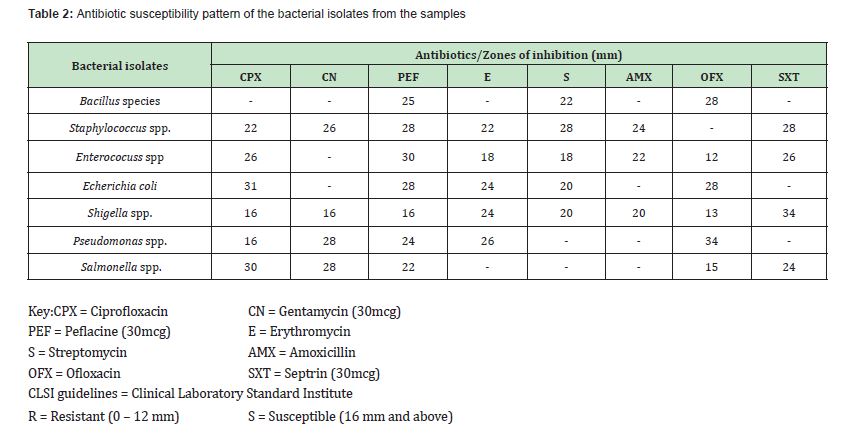
The antibiotic susceptibility pattern of the bacterial isolates from T. trachurus, S. scombrus and G. morhua from Ekeonunwa market, Imo State is presented in table 4.18. From the result, eight (8) antibotics were used during the investigation namely; ciprofloxacin (CPX), peflacin (PEF), Streptomycin (S), ofloxacin (OFX) Gentamycin (CN), Erythromycin (E) Amoxicin (AMX) and Septrin (SXT). The result of the susceptibility levels of the various bacteria investigated is presented as follows.
The result of the antibiotic susceptibility pattern of Bacillus species ranged from not susceptible (-) to 28. The highest susceptibility was recorded with ofloxacin (OFX) and the least susceptibility was in ciprofloxacin (CPX), Gentamycin (CN), Erythroymcin (E), Amoxilcin (AMX) and Septrin (SXT) which all were found not susceptible. The result shows that only three antibiotics out of eight (8) tried as found to inhibit the action of Bacillus species.
The antibiotic susceptibility pattern of Staphylococcus species ranged from not susceptible (-) to 28. The result shows that Staphylococcus showed resistance to only ofloxacin while all the other antibiotics tested showed varying degrees of susceptibility to the action and growth of Staphylococcus. The result of Enterococcus species ranged from not susceptible (-) to 30. The highest susceptibility was recorded in pefloxacin (PEF) (3) and the least susceptibility was recorded in Gentamycin which was found not to be susceptible to the action of Enterococcuss. All the antibiotics tested showed varying levels of inhabitation ability amongst them except Gentamycin (CN). For Echerichia coli, the results of the antibiotics were found to range from not susceptible (-) to 31. The highest susceptibility was recorded with ciprofloxacin (CPX) and the least was with Gentamycin (CN), amoxicillin (AMX) and septrin which showed no susceptibility to Echerichia coli. From the eight antibiotics tested during the study, five (5) were found to be sensitive to the activity of Echerichia coli at varying degrees while three (3) were not sensitive. The result of Shigella species isolated from T. trachurus, S. scombrus and G. morhua shows that it had a susceptibility range of not susceptible (-) to 34. The highest sensitivity was recorded with ofloxacin (OFX) recording 34 and the least sensitivity was recorded with septrin (SXT) which showed no susceptibility. The eight antibiotics tested during the investigation were all sensitive to Shigella at different levels except for septrin which was not responsive.
The Pseudomonas species Isolated, ranged from not sensitive (-) to 34. The highest sensitivity was recorded in trial with ofloxacin (OFX) which recorded 34 and the least was found in streptomycin (S), Amoxicillin (AMX) and Septrin (SXT) which were all found to be non-sensitive (-) to the action of pseudomonas species. From the eight (8) antibiotics tested on the pseudomonas isolate during the study, it was found that five (5) of the antibiotics were sensitive to the bacteria isolated with varying degree of inhibition ability while three (3) were not sensitive. The result of the antibiotics sensitivity pattern on Salmonella investigated ranged from non-sensitive (-) to 30. The highest sensitivity was recorded with ofloxacin (OFX) test which recorded an inhibitive value of 34 and the least sensitivity was recorded with test trials on Erythromycin (E), Streptomycin (S) and Amoxicillin (AMX) which showed no inhibitive action against the activity of Salmonella species. During the investigation eight (8) antibiotics were tested and five (5) showed varying degrees of inhibitive ability while three (3) of the antibiotics were not susceptible to Salmonella species.
Fish has been widely accepted as a good source of protein and other elements necessary for the maintenance of healthy body. It is an important food commodity in the international trade but they deteriorate rapidly especially when storage facilities are lacking.19 Fish are highly perishable and prone to vast variations in quality due to differences in species, environmental habitats, feeding habits and antibiotic treatment (usage) in fish production. Infectious agents associated with water and food products (especially fish) are seen to cause gastroenteritis (diarrhoea or dysentery) in humans, which may result in fatalities. However, the greatest risk posed to human health is the consumption of raw or poorly processed fish and fish products.24
The total loads of the bacterial isolates from the frozen fish samples were found to be at unacceptable levels. Nevertheless, International Commission on Microbiological Specifications for Foods (ICMSF),25 recommended that total coliforms limit per gram for frozen fish should be between 11-500Cfu/g.
A total of seven bacterial species from the various frozen fish samples examined, were isolated across the Ekeonunwa market in Imo state. Some of these organisms were found to cause diarrhea and gastro intestinal diseases in both adults and children. The results of this study are in agreement with the findings of detunde.26
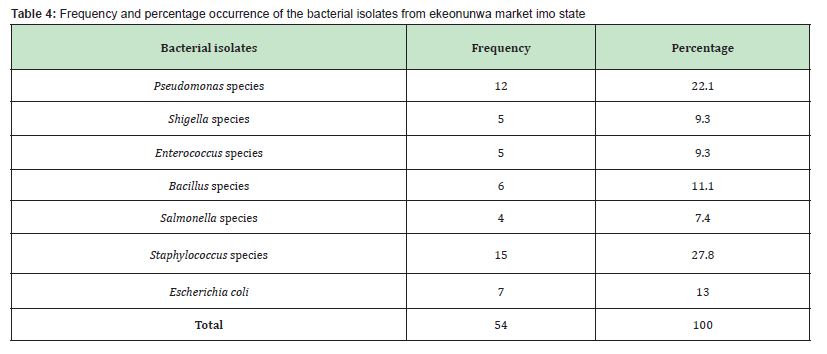
Table 4.1 shows the frequency of occurrence of the bacteria isolates in percentage. The highest bacterial isolate was Staphylococcus species that occurred at 27.8%. The least percentage occurrence was recorded to be Salmonella species which occurred at the rate of 7.4%. The result showed a frequency order of Staphylococcus species (15) 27.8% > Pseudomonas species (5) 22.18% > Escherichia coli (7) 13.0% > Bacillus species (6) 11.1% > Shigella and Enterococcus species (5) 9.3% > Salmonella (4) 7.4%.
The microorganisms isolated and identified from the fish samples can be said to be normal flora of the fish like Bacillus sp.27 The normal microbial flora of the fish are not initially harmful, as they even help in preventing the invasion of the fish flesh by other microorganisms but they become pathogenic when there is an enabling environment that promotes their growth like bad handling which can lead to bruises, poor hygiene and delayed processing and preservation of the fish after harvest.28 The result of this work is in line with the work of Okonta and Ekelemu29 who reported Staphylococcus spp. and Escherichia spp. as the predominant microorganisms affecting frozen fish and causing their spoilage. Contrarily, Nwabueze and Nwabueze30 reported low S. aureus counts when compared to E. coli count in their study. The Isolation of Staphylococcus aureus in this work is of practical impact. It is a sign of poor sanitary condition and lack of adequate packaging and hand of the products as they are always exposed at the markets.31 In the work of Abolagba and Igbinevbo,28 Pseudomonas species was the most prevalent cause of frozen fish spoilage. Subsequently, Abolagba and Igbinevbo reported that Bacillus spp. was present in virtually all fish samples tested, which is also in line with the report of this study. Two Bacillus sp. are considered medically significant; B. anthracis which causes anthrax and B.coagulase also causes food spoilage.32 According to the Center for Food Safety and Applied Nutrition,33 most fish- related food borne illnesses are traced to Salmonella, Staphylococcus spp., Escherichia coli, Vibrio parahemolyticus, Clostridium perfringens, Clostridium botulinum and Enteroviruses.
The presence of Staphylococcus aureus and Enterococcus spp. may be linked to the handlers during processing, storage and sales, the sources of coliforms such as Esherichia coli and Enterobacter spp were reported to be due to process of disection, handling and marketing.34,35 The isolation of Bacillus spp, Salmonella spp and Shigella spp is a cause for concern as both organisms have been reported in food poisoning and other health issues such as typhoid disease. In general, the risk of food borne illness may be reduced by applying the principles of Hazard Analysis and Critical Control Points (HACCP).23 Preventive food safety system in which every step in the manufacture, storage and distribution of a food product is scientifically analyzed for microbiological, physical and chemical hazards, is encouraged. The microbial loads on the fish species sampled in Ekeonunwa market in Imo State were found to be contaminated at various degrees, hence the handling and sanitation conditions of our locals’ markets across the State should be improved to avoid food borne diseases.
Ubaka KG: Analysis, Writing. Ekwuonu NA: Supervision, Review, Ogah OJ: Writing, Review, Editing, Resources, typesetting and research writing, Ogueri C: Review and Nwadiogbu J: Supervision, Review.
None.
This Research received no external funding from any agency.
Regarding the publication of this article, the author declares that he has no conflict of interest.
