

The real random number generation is a crucial problem in computer science. The current generation methods are either too dangerous or too expensive, such as using decay of some radioactive atoms, they are also hard to control. By the uncertainty principles in quantum mechanics, real probabilistic events can be just replaced by the collapse from a superposition to an eigenstate it consists of, such as double-slits interference of a single photon or electron, when the photon or electron hit onto the screen from a free moving state with certain momentum, is from a momentum eigenstate which is a superposition of position eigenstates to collapse onto a position eigenstate which is a superposition of position eigenstates. Schrödinger’s cat paradox is not a paradox, it is an effect, there is something different happens in each half-life period before the atom decayed, to make the atom choose either decaying or not decaying in this half-life period to stay in the next half-life period, whether decay or not is purely probabilistic like an ideal dice. Same matter is able to possess different kinds of properties, because same matter can stay in different states which have different properties, such as wave-particle duality. One eigenstate of a physical quantity can be a superposition of eigenstates of another physical quantity, and the collapse from a superposition to an eigenstate it contains is purely probabilistic like an ideal dice, such probability can be used to generate real random number, and double-slits interference of single photon, with a screen that has photoelectric effect with this photon, real random number may be generated thereby for our computer and other smart things today.
Keywords: Uncertainty principle, Superposition, Eigenstate, Double-slits interference, Real random number
Max Planck published his scientific work on blackbody radiation in 1900, quantum physics was consequently born. After that, developed by Bohr and Heisenberg, quantum mechanics was created and became one of the main pillars of modern physics. In 1925, Heisenberg established the “Matrix Mechanics” which led him to Nobel laureate, and Schrödinger’s “Wave Mechanics” is equivalent to Heisenberg’s work. By quantum mechanics, Heisenberg indicated that there is uncertainty brought about by it. For example, by the commutation relation of momentum  and position
  , i.e.,
  , the fluctuation of them will be related by
 (1)
(1) Which means that the concepts about orbits in classical physics will not stand anymore in quantum physics. Every particle would be either a point with uncertain momentum or a moving wave without certain position. When the stationary particle was released into free movement in space, the momentum will be given randomly from one of the eigenfunctions of momentum and the probability of the particle to have each momentum equals to the square of the parameter before the corresponding eigenfunction in the unfolding polynomial of the particle by the complete eigenfunction set of momentum (which should be multiplied by  if the eigenvalue of momentum
  is consistent). The similar processes in the alternation of a free moving particle into a stationary point. And other physical quantities that have non-zero commutation relations all have uncertainty relations
 (2)
(2)
It is worth mentioning that this uncertainty is a kind of the nature of matter and is not caused by the influences from measurements. Just like what happened in the case of Schrödinger’s cat, either the atom will decay is objective, if it decays then the cat dies, cat is still living when it didn’t decay, Schrödinger’s cat case is not paradox, the radioactive atom is in different states before and after it decayed, different is more, there is something new created in this process from a superposition to one eigenstates thereof, a superposition state of one quality could be eigenstate of another quantity, and vice versa, not all physical quantities could be certain at the same time in one state, different states are figured by the set of physical quantities that are certain, some quantities which commute with each other could have certain value at the same time, while some quantities which don’t commute with each other also can’t have certain value at the same time.
This could be shown mathematically, if
 (3)
(3)
,  and
and  are two physical quantities respectively, and they have complete sets of eigenstates that any state can consist of. The completeness may originate from physics, if a quantity can be measured, then any possible state can collapse onto an eigenstate of it, so that this quantity of any state could be certain, therefore the eigenstates of an existing quantity must be capable to compose any possible states linearly, i.e., this set of eigenstates are complete, so that any possible state can be a superposition of this complete set of eigenstates. The process of the collapse is something different never happened before, probabilistic, just an ideal dice, the superposition collapse into any one eigenstate of all eigenstates it consists of, the probability to collapse onto any one eigenstate is the square of the magnitude of the coefficient of this eigenstate, times
  where
where  is the eigenvalue of the physical quantity on this eigenstate, if the eigenvalues of the eigenstates are continuous. Supposing the complete set of eigenstates of and are


,
and  are continues eigenvalues of physical quantities and , then since
  ,
,  (4)
(4)
this shows  ,
,  is still an eigenstate of
  , that is,
  , and
, and  are a complete set of eigenstates,


,

, since each are not linear relevant to each other, there must be  , which makes


, still since each
is not linear relevant to each other:
 (5)
(5),
 must be a constant, related to , the eigenstates of quantity must be also eigenstates of quantity if and commute with each other, i.e., .
The uncertainty relation (2) could also be proved,


, where ψ is any state to be measured, supposing
 , then since
 (6)
(6)
for any existing quantity and ,  ,
,  , i.e., and
  both are Hermitian, this may be caused by a Hermitian operator of the physical quantity makes its eigenvalues to be real number,


, since ,

,  , however, this is necessary but may be not sufficient reason why the operator of a physical quantity that exists must be Hermitian, only physics can explain the hypothesis of any mathematics. Anyway, following (6),
 (7)
(7)
 (8)
(8)
, (6) and (7) are valid for any  , therefore, if
  , then

 (9)
(9)
, if using  and
and  to replace and respectively, then
  , and then (9) becomes

, this is

(10)
, the uncertainty relation, for position and momentum,
 (11)
(11)
When a measurement was taken, the particle in previous state must choose an eigenstate it consists of to collapse onto before the measurement was taken, and this process is objective and probabilistic, something new will be created during the particle choosing which eigenstate to collapse, by definitely of material, which is objective existence, here new material is created, when the particle chose one eigenstate of all eigenstates it could possibly collapse, something different never existed before is created, make it be one certain eigenstate of the physical quantity to be measured and this is different from its previous state. The two states before and after the particle to choose which eigenstate to collapse onto are different, different is more, here is something never existed before be created, and this is material, new material is created during the measurement, why it is this state not the other could only be explained by consciousness, just because it likes it chose this eigenstate not any other eigenstate to collapse onto.
For example, as the picture in Figure 1 showed, a single electron is moving from the gun to the screen. Between them there is a wall with two adequately thin slits, and the distance between the two slit is as the wave length of the electrons shot which is calculated by De Broglie formula  , so that electron wave can interfere with itself when passing the two thin slits.
According to Schrödinger function


 (12)
(12)
the electron is a spherical wave when moving freely with constant momentum in the space. And the electrons would apparently be obscure by the wall and only two spherical waves from two slits would pass. This is a case of Young’s two micro holes interference. The wave functions of the two waves are
 (13a)
(13a)
 (13b)
(13b)
, as the Figure 1 shows below,  , the two spherical waves have same phase when being emitted from two holes, the phase difference of them at a point on the screen is
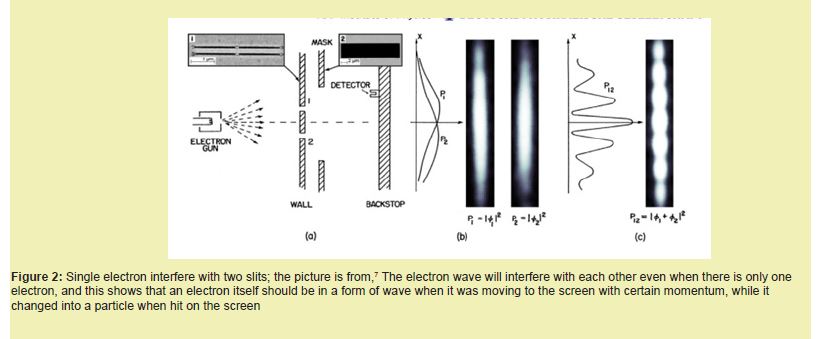
  . From Figure 1, one can see the probability distribution the same as that of the experimental results in Figure 2.
If there is no screen behind, the electron wave would move freely indefinitely with certain momentum, and the wave would constantly be
 (14)
(14)

When the screen was placed somewhere, the electrons bombarded onto it would be pinned down to the screen. Its wave equation would consequently change into

, and its solution is
 (15)
(15)
the electron moving with constant momentum interfere with itself after passing the two slits, became (14), and then becomes (15) when hitting onto the screen. Now one can see that the wave functions of the electron are different when moving freely and hitting on the screen.
Generally, any measurement is same as such process showed above, the state to be measured is superposition of the eigenstates of the physical quantity to be measured, the state needs change to be another state to have certain value of the quantity to be measured, by choosing one eigenstate it consists of two collapse, this process is probabilistic, something existing and new will be created after the collapse, i.e., new material is created, and only consciousness could explain what created such material, why it is this eigenstate not the other that the superposition chose to collapse onto, consciousness is showing itself to create material here.
Schrödinger’s cat paradox is not paradox, it is just an effect, that the atom was in different states before and after it decayed, and whether it will decay in a half-life period is 50%, this is similar to the previous case of double-slits interference of particles, a particle moving with certain momentum has no certain position but certain probability distribution of the position it will appear when it hit onto the screen, it is wave when it was moving, and can interfere with itself after passing the double-slits, same as photon in Young's double-slit experiment, its probability distribution of the position it will appear when hitting onto the screen is a pattern of the interference of the two waves when it was passing the two slits respectively, it passes the double-slits like a wave, appear at a possible position on the screen as a particle with the probability distribution of this wave. In the Schrödinger’s cat effect, the probability of distribution is just whether the atom will decay after a half-life period, it moves with constant energy in imaginary space of time, and whether it will decay after a half-life period is purely an ideal dice, it will choose one of them after a half-life period, which it will choose is purely probabilistic, depends on which one it likes. There is same something different happened here at each end of half-life period, the atom will just choose either decaying or not decaying at this time. To write this mathematically, what happens on Schrödinger’s cat is that the cat stays in a superposition state of  , and after a half-life period, it will collapse onto one of
  and
and  probabilistically, and
  since it is a same atom before decaying if the atom didn’t decay mention above, there is something different created during each half-life period, the atom will choose whether to decay or not at each ending of the half-life period since its original state, the cat’s life is just same as this radioactive atom, how long the atom will live, how long the cat will live.
Heisenberg’s uncertainty principle pointed out that sometimes a physical quantity may be uncertain for a state, and this state is called a superposition of the eigenstates of this physical quantity. A superposition doesn’t mean that this state has multiple values of this physical quantity simultaneously, such as an electron at an eigenstate of the momentum in an atom cannot be regarded as having multiple positions, it just doesn’t have a position because the state it was in is a wave, only after it hit onto the screen could it be a particle which has certain position, and the position it will appear is purely probabilistic, like an ideal dice, according to the probabilistic distribution, which is the intensity distribution of the wave. For example, in the case of double-slits interference of single particle wave, when the particle was moving with constant momentum, its wave function became
 (16)
(16) , where
 is the coefficient for the state to keep same intensity, which is the number of the particles, after the interference,
 (17)
(17) and its probability distribution of position is  , which is related to the phase difference of the two waves before they interfere, . Since same matter can have different states, the paradox in the explanation of the wave-particle duality can be solved by this argument: when particle stay in a momentum eigenstate, it has definite momentum without definite position, and in a position eigenstate which is
  function, it has certain position without certain momentum,
  , eigenfunction of position indeed is superposition of eigenfunctions of momentum mathematically. How one thing could have multiple kinds of properties? For same matter can stay in different states, such as wave state and particle state, it is therefore able to have different kinds of properties such as wave and particle. Multiple kinds of properties of same matter exist in different kinds of states it may stay in.
Uncertainty principle reveals that same matter can be on different states with different kinds of properties. In such way, same matter can have multiple kinds of properties, this is the famous wave-particle duality brought up by Bohr. Matter at an eigenstate of a physical quantity could be a superposition of eigenstates of another physical quantity, and vice versa, as the case of momentum and position shows, there is an uncertainty relation between them, because the momentum operator  doesn’t commute with position operator
  , their eigenstates are not common, therefore the momentum eigenstate is a superposition of position eigenstates and vice versa, to measure where the particle will be on the screen in the double-slits interference of a photon or electron as figure 2 shows would make an eigenstate of momentum without certain position collapse onto an eigenstate of position state without certain momentum, where the particle would appear on the screen is purely probabilistic, like an ideal dice, and the probability distribution is in terms of the intensity of its wave state before it collapsed to be a particle on the screen. 1-10
Utilizing such an ideal dice, real random number could be generated, and for feasibility we could use just the uncertainty relation between momentum and position with photon or electron to generate real random number for computer or other smart things today, to make a double-slits for the interference of photons, which is better to be laser, with a screen that has photoelectric with this frequence of laser behind the slits, then count the number of times when the photon appear on different regions of its interference pattern on the screen, the sequence of where the particle appeared on the screen is just the random number sequence we want, we should make the number of photons in the laser be dilute enough to enable there are not too many photons hitting on the screen at the same time, and different numeral systems like binary, octal and hexagonal are all feasible for generating real random number according to which region of the interference pattern of the wave on the screen the particle appeared.
None.
This Mini Review received no external funding.
Regarding the publication of this article, the author declares that he has no conflict of interest.
