

The article presents scientific results on the creation of new promising varieties of a number of agricultural crops, which are currently widely cultivated in the lands of farms in Tajikistan. Based on the analysis of the work of local and foreign breeders, it was found that in the future, such breeding methods as remote interspecific hybridization, mutagenesis and introduction will play an important role in the adaptation of agricultural crops to climate change. Due to the fact that global climate change causes an increase in air temperature, an increase in the level of soil salinity, a lack of moisture in the soil, an increase in the number of pests and plant diseases, etc., it is necessary to strengthen breeding and genetic research in the future.
In this regard, the goal of our long-term breeding work was to obtain new intensive varieties of such important agricultural crops as wheat, oats, Jerusalem artichoke potatoes and cotton in the conditions of Tajikistan. These new varieties of agricultural crops, which were obtained by scientists of the Institute of Botany, Plant Physiology and Genetics of the National Academy of Sciences of Tajikistan (IBPGE) and the Institute of Agriculture (IA) of the Tajik Academy of Agricultural Sciences, are more resistant to various agroecological growing conditions. These highly productive new varieties of a number of agricultural crops were obtained through an effective combination of classical breeding methods with modern biotechnology methods, are more adapted to climate change, resistant to pests and diseases when they are cultivated in various agroecological conditions of the Republic of Tajikistan.
Keywords: Selection, Hybrids, Variety, Productivity, Early maturity, Resistance, Field crops, Cotton, Wheat, Oats, Potatoes, Jerusalem artichoke, Adaptation, Climate change, Tajikistan
Many scientists report that collecting and preserving various forms and samples of agricultural crops play an important role in the selection process to create new varieties adapted to future climate change.1-4 To create new varieties of agricultural crops, a combination of traditional selection methods and fundamental achievements and methodological approaches in plant physiology and biochemistry, genetics and agricultural technology is required.5-11
In this regard, scientists in Tajikistan pay special attention to the issues of collecting, preserving and involving various genotypes of agricultural plants and using them in the breeding process.12-18 According to this provision, the initial stage of selection should be based on genetic and selection management of the productive process in plants.6,18,19
In connection with the above, the purpose of this work was, based on the use of selection methods and biotechnology for the creation of new promising genotypes of agricultural crops, to study their phenotypic variability, polymorphism of traits, intensity of photosynthesis and productivity indicators of different genotypes in various agroecological conditions.
In the process of evaluating the source material, hybridization, selection and seed production work on the development of new varieties of agricultural crops, we used elite seed material of wheat (Triticum aestivum L.),oats (Avena sativaL.),potato (Solanum tuberosum L.),Jerusalem artichoke (Helianthus tuberosus L.) andcotton (G.hirsutum L. and G. barbadense L.). The breeding work was carried out in the experimental plot of the Institute of Plant Botany, Physiology and Genetics of the National Academy of Sciences of Tajikistan, located in the eastern part of Dushanbe, at an altitude of 840 m above sea level, and with cotton crops - in the experimental plot of the Institute of Agriculture of the Tajik Academy of Agricultural Sciences, located in the village of Sharora in the Hissar Valley, at an altitude of 650 m above sea level. The soils of the experimental plots were typical gray soils, with a humus content in the arable layer of -1.0-1.5%. The sum of effective temperatures during the growing season of plants is 2500-30000 C, and the amount of precipitation is 500-600 mm during the year. Agrotechnology for growing varieties and hybrids of agricultural crops was implemented based on the conditions recommended for the area, and genetic selection work. When growing varieties of agricultural crops, N70P80K90 /ha were applied under grain crops, N90P90K100 /ha under potatoes and Jerusalem artichoke; N100P120K110 /ha under cotton. Mineral fertilizers were applied during sowing and as top dressing of varieties of agricultural crops. Recommended types and rates of various pesticides were used against pests and diseases of varieties. During the growing season, the following vegetative irrigations were carried out: for grain crops 4-5 times, with the consumption of irrigation water - 1500-2000 m3; for potatoes and Jerusalem artichoke - 6-8 times, with irrigation water consumption of 2700-3500 m3, and for cotton - 8-10 times, with irrigation water consumption of 4000-5000 m3.
During the vegetation period of plants, basic morphological and phenotypic observations were carried out, and the main phases of development of plant varieties and hybrids were determined.
In the selection programs of scientists of the Institute of Botany, Physiology and Genetics of Plants of the National Academy of Sciences of Tajikistan, more than 100 valuable samples of wheat, 10 samples of oats, 50 samples of potatoes and 25 samples of Jerusalem artichoke were used. The seeds of these samples were collected as a result of an expedition in remote villages of the Republic of Tajikistan, from mountainous areas (at an altitude of 1800-3000 m above sea level), and also received from genetic centers of various research institutes of the Russian Federation, Belarus, Uzbekistan, Kazakhstan, China, Afghanistan and other countries. Over the years of research, scientists from the Institute of Agriculture of the Tajik Academy of Agricultural Sciences have carried out 2,660 crosses of cotton in 92 hybrid combinations (with castration of flowers of maternal forms), 1,680 hybrid bolls and more than 20 thousand hybrid seeds (F0) of cotton were obtained, which were studied up to F8-10 generations.
Statistical processing of the obtained scientific data was carried out according to the method of Dospekhov, 1985, using the computer program Microsoft Exile, 2010.
The main selection achievements obtained over more than 10-15 years by Tajik scientists on the main crops in the conditions of Tajikistan are presented in this scientific work.
Wheat (Triticum aestivum L.). Based on the use of the classical selection method of selection in 2010, among the population of plants of the local wheat variety "Zafar" ("Victory"), an original modified plant was isolated, which differed sharply in the color of the leaves and the height of the plants from the plants of the original wheat variety. Further study of this plant in the following years of the study showed that the isolated wheat sample differed from the maternal variety "Zafar" in a number of genetic traits. In our opinion, this modified plant arose on the basis of natural mutagenesis in the field conditions of the experimental site of the Institute of Botany, Plant Physiology and Genetics of the National Academy of Sciences of Tajikistan.14 The new isolated wheat sample was studied and propagated during 2011-2021, in various breeding nurseries, and in 2022, based on the decision of the Academic Council of the Institute of Botany, Plant Physiology and Genetics of the NAS of Tajikistan, it was named the variety "Bakhti Istiklol" ("Happiness of Independence") and transferred to the State Commission for Variety Study and Protection of New Varieties of Agricultural Plants of the Ministry of Agriculture of the Republic of Tajikistan.
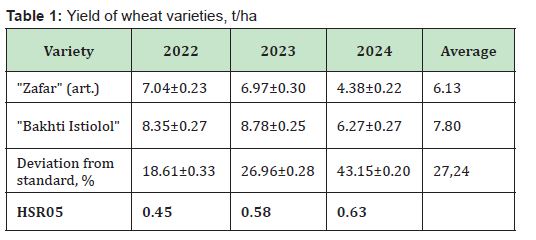
The new wheat variety "Bakhti Istiklol" significantly exceeds the parent wheat variety "Zafar" in a number of genetic traits, such as ear length (by 20.76%), straw and leaf weight (by 13.69%), ear weight (by 80.75%), the number of grains in an ear (by 65.26%), grain weight of one ear (by 23.53%) and 1000-grain weight (by 28.05%). The new variety "Bakhti Istiklol" ripens 15 days earlier than the original parent variety and exceeds the "Zafar" variety in yield by 27.24% Table 1.
The grain color of the new wheat variety “Bakhti Istiklol” is white, while that of the original variety is red Figure 1.
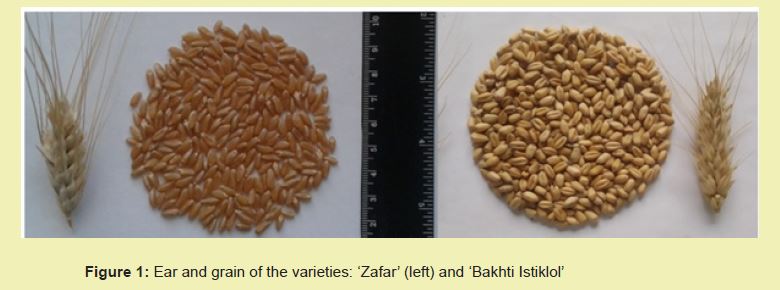
However, the new wheat sample - "Bakhti Istiklol" is inferior to the "Zafar" variety in such features as the length of the ear with awns (by 16.78%) and the weight of the chaff (by 29.03%). Also, this variety is an early-ripening variety, the length of the stems reaches 55-60 cm, multi-leafed, broad-leaved, very green leaf color (Authors: Partoev K., Sattorov B.N.).
Oats (Avena sativaL.).The new oat variety "Nazar" ("Vzglyad") was bred as a result of long-term selection work by us using the classical family selection method among the population of the variety sample from the collection of the Institute of Botany, Plant Physiology and Genetics of the National Academy of Sciences of Tajikistan from sample No. 3. This oat variety was studied and propagated in various breeding nurseries during 2014-2021 using classical selection methods, individual selection (Authors: Sattorov B.N., Kamolov N.K., Partoev K.). The variety has a number of distinctive features from the original variety sample and other oat varieties in terms of grain color, stem height, early maturity, leaf size, the number of grains in spikelets (2-3 pcs. in each spikelet) and high yield. Also, the new oat variety "Nazar" differs from the original variety sample in bush habitus, leaf color and plant height. The new variety has heavier full and greater 1000-grain weight than the original variety (by 15-20%). The plant height is 5-7 cm higher than the original oat sample. The variety yield on dry lands reaches 2.0 t / ha, and on irrigated lands up to 3.3 t / ha, which is 0.5-.0.7 t / ha more than the original oat sample No. 3. The biological feature of this oat variety is white grain color, tallness, early maturity, high yield, wider leaves with a bright dark green color, which distinguish it from the original and other oat varieties. The variety is high-yielding and resistant to lodging and fungal diseases. In August 2022, the new sample was named "Nazar" at the Scientific Council of the Institute of Botany, Physiology and Genetics of Plants of the National Academy of Sciences of Tajikistan and transferred to the State Commission for the Study and Protection of New Varieties of Agricultural Crops under the Ministry of Agriculture of the Republic of Tajikistan.14
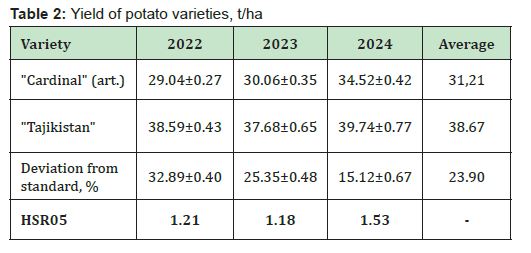
Potato (Solanum tuberosum L.). Based on the hybridization of two new potato lines:387521.3 x Aphrodite in the International Potato Center (CIP, Peru) a new potato hybrid was obtained. We received seeds of this hybrid (F1) in 2005. As a result of breeding work in the mountainous zone of Tajikistan (at an altitude of 2700 m above sea level) during 2006-2015 a new promising potato clone was selected, which was subsequently named the variety "Tajikistan" and submitted for testing to the State Commission for the Study and Protection of New Varieties of Agricultural Crops under the Ministry of Agriculture of the Republic of Tajikistan in 2012. By the decision of this commission the new potato variety "Tajikistan" was zoned in the republic in 2015. (Authors: Partoev K., Aliev K., Karimov B., Melikov K., Sulangov M., Nazarova N.). To speed up the selection process, we used the method of micro-cutting of test-tube plants in vitro, planting test-tube plants and microtubers in a light room, greenhouse and in the open field. By propagating test-tube plants and microtubers in a light room in the autumn-winter - spring period, we managed to halve the time it took to study and accumulate sufficient selection material for this clone. The variety is tall, the stem length reaches 80-100 cm, multi-leafed, the leaves are dark green. It forms few flowers, the color of the flowers is purple, the flowering period is short. The variety has a small formation of berries and their small size. The tubers are round-oval, red in color and have good taste. The flesh is yellow with a purple tint. The depth of the buds is superficial. The color of the buds and sprouts is purple. The variety is mid-late with a vegetation period of 110-115 days. It is resistant to high temperatures and lack of moisture in the soil. Currently, the new potato variety "Tajikistan" is cultivated on an area of more than 8 thousand hectares and exceeds other potato varieties in yield by 20-30%.20
The Tajikistan variety is more productive than the zoned Cardinal potato variety by 15.12 – 32.89% (Table 2).
Currently, based on the use of traditional selection methods and biotechnology, we have obtained such new promising potato varieties as "Faizi Istiklol" and "Mastchokh", which are currently being tested by the State Commission for Testing and Protection of New Varieties of Agricultural Crops under the Ministry of Agriculture of the Republic of Tajikistan.
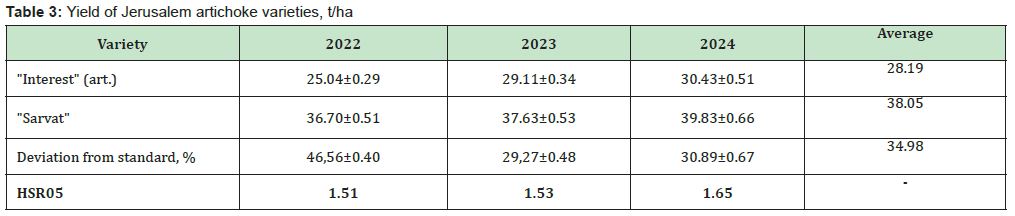
Jerusalem artichoke (Helianthus tuberosus L.). During 2005-2015, as a result of using the selection method among the Jerusalem artichoke variety "Interes", a new Jerusalem artichoke variety "Sarvat" ("Wealth") was isolated. The new Jerusalem artichoke variety, unlike the parent variety "Interes", has more even and smooth tubers, which are convenient for canning tubers Figure 3. This variety was zoned in the republic in 2017. Under production conditions, it exceeds other varieties in yield by 25-47%. The yield of tubers of the "Sarvat" variety is 36-39 t / ha and in this indicator exceeds the standard Jerusalem artichoke variety "Interes" by 30-46% Table 3. The total biological mass of the "Sarvat" variety is 52-67 t / ha. Jerusalem artichoke tubers are a good means for reducing the sugar content in human blood (Authors:Partoev K., Akhmedov Kh.M., Mirzoev N.R., Saidaliyev N.Kh. and Yasinov Sh.M.). The variety is grown on rocky and low-fertility soils.17
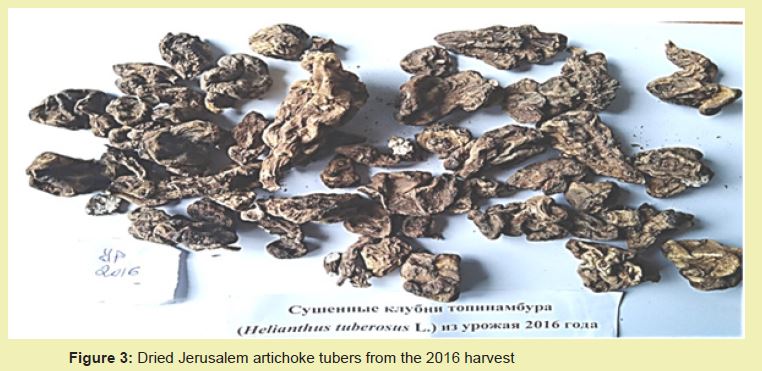
It should be noted that our research has established that dried Jerusalem artichoke tubers have an exceptionally important valuable property, which for more than 10 years does not lose its nutritional properties as a food product in the future. As is known, many food products, such as dried apricots, mulberries, nuts, grain and legumes, lose their nutritional properties or are spoiled by pests within 2-3 years. Unlike other dried fruits, dried Jerusalem artichoke tubers can retain their useful and nutritional properties for use in food for a long time under natural storage conditions (without the use of refrigerators) and are not damaged by pests Figure 3.
Therefore, dried Jerusalem artichoke tubers can be used as a valuable strategic raw material in solving food security in the face of climate change in the future.
Cotton (G.hirsutum L. and G. barbadense L.). The conducted studies have shown that interspecific genotypes of cotton species - G.hirsutum L. and G. Barbadense L. have more powerful spreading bushes, elongated bolls, long fiber and emerald undergrowth in selection, i.e. in heterotic hybrids, the morphological features of cotton species G. Barbadense L. dominate.
Hybrids involving wild and semi-wild forms of cotton, such as SSP. ruderalle, G.morrile, were tolerant to Verticillium wilt (Verticillium dahlia kleb), with the exception of hybrids involving G. zarumille, where most hybrid plants were affected by Verticillium wilt.
Hybrid plants of the combination G. Morrile x Sorbon, G.ruderalle x Sorbon, were found to be semi-sterile. Genotypes obtained with the participation of wilt-resistance donors: Donor-1, (TSKHN-2 x TSKHN-7 BSL) L-248; Donor-2 (Bukhoro-6 x G.ruderalle rud.Form from the state of Oaxaca, Mexico) L-43 had a spreading bush shape with hanging fruit (sympodial) branches, were late-ripening, with a weak set of fruit formation and had a high degree of resistance to verticillium wilt. In the hybrid combination, resistance to wilt from the standard variety "Hisor" is higher by 20.3-30.2%.
According to the heterosis effect, the attracting ability of the boll, i.e. yield, early maturity, wilt resistance and fiber quality, genotypes obtained from distant geographic crossings involving the varieties Carmen, G.ruderalle, S-6524, L-Dusti-IZ, L-748, Sorbon, Sugdien-2, Bukhoro-6 were distinguished. Thus, hybrid plants of the combination ssp.ruderalle x Sorbon, Carmen x D-2, L-Dusti-IZ x S-6524 had a pre-frost yield of raw cotton per plant of 64.1; 66.6 and 126.7 g, respectively, i.e. higher than the standard variety "Khisor" by 26.0-88.6 g. The excess in raw cotton yield per plant in the hybrids L-Dusti-IZ x S-6524 reaches 60.8% of the average value of the trait of the two parents.
According to the fiber yield, the following genotypes stand out: Bukhoro-6 x Sorbon, Sorbon x G.zarumille, Carmen x L-Dusti-IZ, Sorbon x Carmen, Sugdiyon-2 x Sorbon and G.morrile, for which the fiber yield was 37.2; 38.1; 38.9; 40.0 and 40.3%, respectively, while for the standard this figure was 35.0%.
Hybrid combinations Sorbon x S-6524, S-6524 x Bukhoro-6, Bukhoro-6 x Sorbon had the mass of raw material of one capsule from 7.5 to 7.8 g. i.e. the attracting ability of capsules is higher than the named genotypes, they pumped plastic substances from vegetative to generative organs. Genetic analysis of genotypes indicates good combining ability of a number of parent varieties involved in hybridization. According to the general combining ability, the Sugdayen-2 variety stands out by the length of the fiber, where the effect of the general combining ability (GCA) is qi = + 0.40. In this case, the GCA variants turned out to be lower than the specific combining ability (SCA) variant Table 4.

In terms of fibre yield, the Sugdien-2 variety had a high OKS index of qi=+0.57 and L-Dusti-IZ qi=+0.97. The Sorbon variety had a very low OKS index of qi=-1.32.
During 2009-2022, 92 hybrid combinations were studied on a naturally wilt-infected background at the Agrosanoat farm in the city of Tursunzade.
Analysis of the studied genotypes indicates that in most cases interspecific hybrids, especially those obtained with the participation of varieties of the Sugdien-2 type, were late-ripening by 6-9 days compared to the standard variety "Khisor", low-yielding, and sterile and semi-sterile forms were distinguished.
Thus, as a result of rigorous and targeted selection as a result of breeding work in 2010-2022, cotton varieties "Barakat" and "Kubodiyon-30" were obtained and transferred to the State Commission for Testing and Protection of New Varieties of Agricultural Crops under the Ministry of Agriculture of the Republic of Tajikistan.
It should be noted that we obtained collection samples of agricultural crops on the basis of scientific cooperation agreements with breeders from different countries of the world.14,16,17,21 Particularly productive was the scientific cooperation of scientists from the IBFGR NAST with scientists from the International Potato Center in Peru (Lima) to study various potato samples in the conditions of the valley and mountain zone of Tajikistan.10 Useful cooperation between Tajik scientists and scientists from Peru on potato breeding and genetics was carried out during 2005-2015, thanks to which valuable potato samples were obtained.20,22 The breeding achievements achieved by scientists of the Institute of Botany, Physiology and Genetics of Plants of the National Academy of Sciences of Tajikistan in collaboration with scientists of the Tajik Academy of Agricultural Sciences and the Tajik Agrarian University named after Sh. Shotemur are valuable material for Tajik scientists and breeders to increase the yield of a number of agricultural crops against the background of climate change in the future.15,20
Using the method of propagating test tube plants and microtubers in a light room in the autumn-winter - spring period, we managed to halve the time required to study and accumulate sufficient selection material for new improved potato clones.10,13,22,23 Based on this method, a new variety of potato "Tajikistan" was created, which is tall, the length of the stem of which is 100-120 cm, has many leaves. The new variety of potatoes forms few flowers and berries compared to other varieties. The new variety of potatoes has round-oval tubers, red color and good taste. The color of the flesh is yellow, with a purple tint. The depth of the eyes is superficial, it is mid-late with a vegetation period of 110-115 days. It is resistant to high temperatures and lack of moisture in the soil. Currently, the new variety of potatoes "Tajikistan" is cultivated on an area of more than 8 thousand hectares and exceeds other varieties of potatoes in yield by 20-30%.20,22
As a result of using the selection method - selection among the Jerusalem artichoke variety "Interes" (Russian selection), a new Jerusalem artichoke variety "Sarvat" ("Wealth") was isolated, which differs from the original variety "Interes" by its more even and smooth tubers.17
Selection selections based on attraction indicators yield per plant reached 126.7 g for the genotype “L-Dusti-IZ x C6524”.15
The best value of the effects of the general combining ability for early maturity are the varieties "C-6524" and "Sorbon", and for the length of the fiber "Sugdien-2". The variety "C-6524" has a specific combining ability inferior to the variants of the general combining ability, meaning that early maturity is controlled by additive genes. As a result of strict and targeted selection in breeding and competitive nurseries in 2010-2022, the varieties "Barakat" and "Kubodiyon -30" were identified and transferred to the State Commission for Variety Testing of Agricultural Crops and Variety Protection under the Ministry of Agriculture of the Republic of Tajikistan.24
Thus, scientistsInstitute of Botany, Physiology and Genetics of Plants of the National Academy of Sciences of Tajikistan and Tajik Agrarian University named after Sh. ShotemurBased on the use of classical selection methods, their improvement and modern biotechnology, new promising varieties of cotton, wheat, potatoes, Jerusalem artichoke, oats and other agricultural crops have been obtained to date, which are widely cultivated in the fields of farmers in the republic. The new varieties of agricultural crops obtained are more adaptive to climate change and give a greater economic effect when grown in various agroecological conditions in the republic. In the future, to increase the adaptive potential of new varieties of agricultural crops to climate change, it is necessary to use genotypes of local samples in breeding programs and strengthen cooperation with scientists and breeders in other countries of the world.
None.
This Research Article received no external funding.
Regarding the publication of this article, the authors declare that they have no conflict of interest.
