

The Fish stock status: growth rates, recruitment, Maximum Sustainable Yield (MSY), Mortality and Exploitation rate of B. nurse in Oguta lake, Nigeria, were investigated. The study was aimed at providing baseline information for the conservation and management strategies for the sustainability of its fishery. Standard lengths of 174,296 samples of B. nurse caught with assorted fishing gears were taken fortnightly from January to July, 2023. Data were analyzed by Electronic Length Frequency Analysis (ELEFAN II) fitted into the Von Bertalanffy Growth Model (VBGM). The VBGM for this study was L(t) = 35.70[1 – e-0.29(t – 3.05)]. Estimated Total Mortality (Z) was 1.98 yr-1, Fishing Mortality (F) = 0.26yr-1 and Exploitation rate (E) was 0.15yr-1. B. nurse was not over-exploited in Oguta Lake but the fishing is not operating at its MSY and the Reproductive load is low indicating that there should be restriction on the mesh sizes and closed fishing within the identified recruitment period of the Month of May, every year to avert the future collapse of B. nurse fishery in the lake.
Keywords: B. nurse, Oguta Lake, Stock status, MSY, Conservation, Exploitation, Management strategies
The knowledge of fish stock status: growth rates, Age, recruitment (length/age of first capture), Mortality and Exploitation rates are necessary for the conservation and management of the fish. According to Fish Base1 Brycinus nurse also known as the Nurse tetra is presently listed as least concern by International Union for Conservation of Nature (IUCN). This classification indicates that the species is not considered threatened with extinction at the global level. However, Froese & Pauly2 opined that local population may still face threats and consistent monitoring is needed to ensure the species continues in good health.
Oguta Lake is the largest naturally-occurring lake in south-eastern Nigeria. Located at 5°42’33”N and 6°47’33”E, it is a source of water supply and Fisheries resources to neighboring settlements and beyond. The lake is imbued with abundant ichyo-fauna.3
Amongst the commercial fish species of Oguta Lake is B. nurse. Several studies have been carried out on B. nurse4-8but there are no published works on the stock status of the species in Oguta Lake.
Therefore, this study is aimed at investigating the stock assessment, viz; growth rates, recruitment, Maximum Sustainable Yield (MSY) Mortality and Exploitation rates of B. nurse in Oguta Lake in view of providing information for the conservation, sustainability and management policies for the fishery.
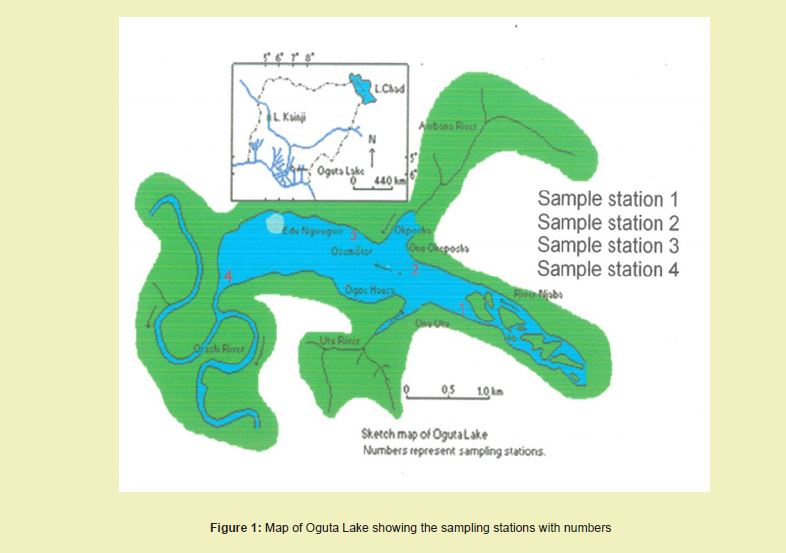
Four areas within the main basin of Oguta lake were designated as Sampling Stations Figure 1 Assorted Fishing gears; with mesh sizes > 2.5cm, hook and lines, basket and traps were used to catch fish fortnightly from January to July, 2023 by seasoned fisherfolks. Catches of local fish mongers were also examined. The catches were sorted into their different species using identification keys of Paugy9 and Adesulu and Sydenham.10 Standard Length (S.L) measurements of the samples were taken to the nearest centimeter (cm). The Data were grouped into 1-cm interval, monthly and analyzed using Electronic Length Frequency Analysis (ELEFAN II) of FiSAT (FAO – ICLARM Stock Assessment Tools) software explained in details by Gayanilo.11 then fitted into the Von Bertalanffy Growth Model (VBGM)
L(t) = L∞[1 – e-k(t – to)]
Where,
L(t) = Length of fish at age, t
L∞ = Asymptotic Length (Maximum Length the fish will attain at that particular ecosystem)
K = the growth coefficient or the rate to which the fish grows to L∞
to = theoretical time when the fish length is zero
The total mortality (Z) was estimated by the length-converted catch curve12 and the natural Mortality (M) also estimated by using Pauly’s empirical formula. The Fishing Mortality (F) was Z – M, since Z = F + M.
The Exploitation rate (E) was calculated by the quotient E = F/Z.12
Relative Yield per recruit (Y’/R) was estimated by the model of Beverton and Holt13 as modified by Pauly and Soriano,13 incorporated in the FISAT software. With reference to FAO14
Y’/R = 1 indicates that the fishery is operating at its Maximum Sustainable Yield (MSY).
Y’/R < 1 indicates that the fishery is not operating at its MSY and needs room for improvement.
Y’/R > 1 is not biologically possible as it would indicate that the fishery is producing more yield than is sustainable.
Probability of capture was estimated from the probability curve; L25 = capture of 25% of the stock, L50 = 50% fish capture and L75 = 75% of capture. Lc = Least Length/size of first capture visible (Hoggarth 2006).
Length at first maturity (Lm) was derived from
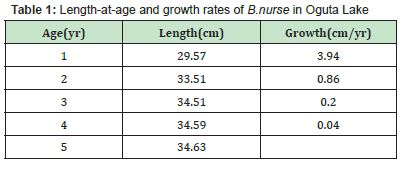
A total of 174,296 samples were examined ranging in size from 9 to 34cm with mean ± s.d (22.0 ± 1.47cm). In Figure 2 is shown the ELEFAN II plot while in Table 1 is presented the length-at-age and growth rates. The VBGM was:
L(t) = 35.70[1 – e -0.24(t – 3.05)]
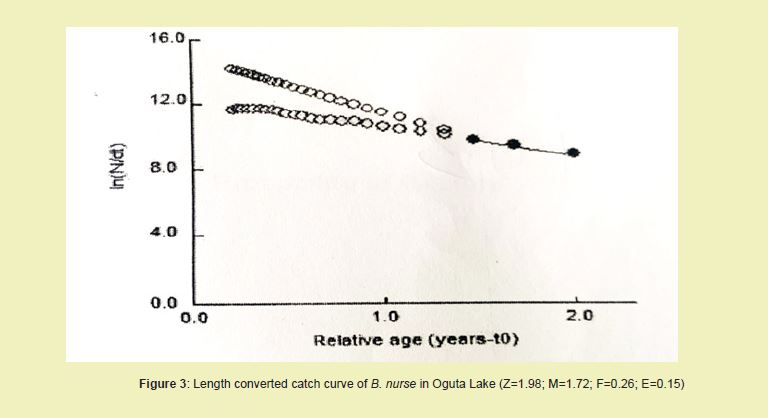
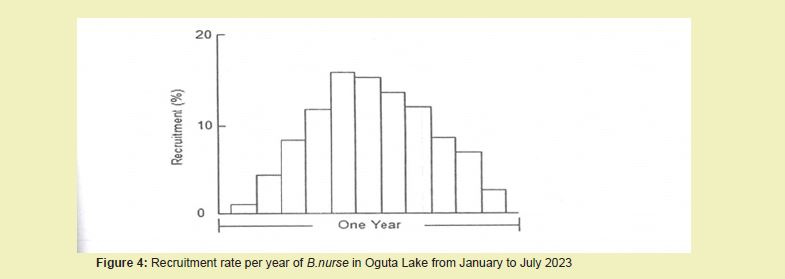
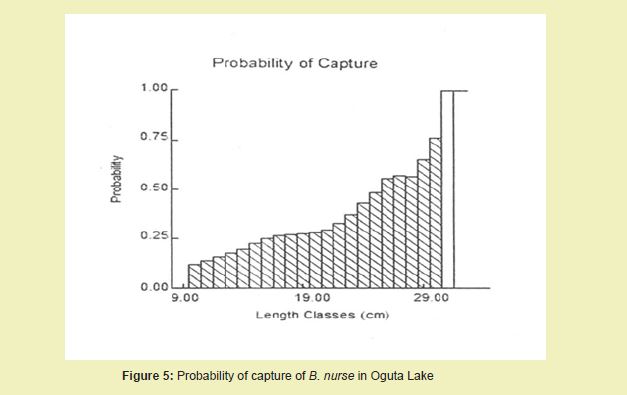
The L∞ estimated was 35.70cm, Z = 1.98yr-1, M = 1.72 yr-1, F = 0.26yr-1 and E = 0.15yr-1. In Figure 3 is the length-converted catch curve. Recruitment per year is shown in Figure 4 indicating peak in the fifth month of May. Probability of capture plot is depicted on Figure 5 showing L25 = 9.00cm, L50 = 12.00cm and L75 = 29.00cm Lc = 9.00cm and Lm = 25.80cm.
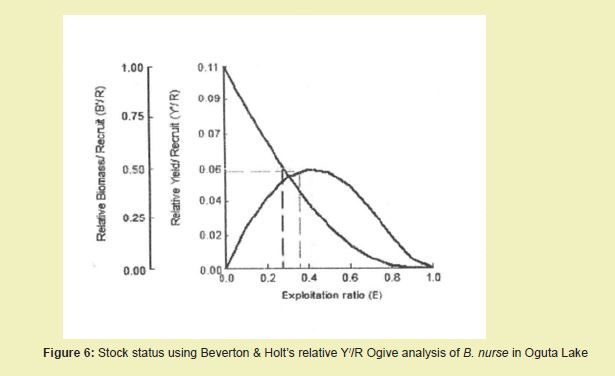
The stock status of B nurse shown in Figure 6 indicates that Y//R < 1 meaning the fishery is not operating at its maximum sustainable Yield.
The analysis also indicated that the exploitation rate at which maximizes Yield per recruit produced Values of Emax = 0.421yr-1, E10 = 0.350yr-1 and E50 = 0.278yr-1. The Reproductive load Lc/L∞ = 0.280 indicates over fishing.
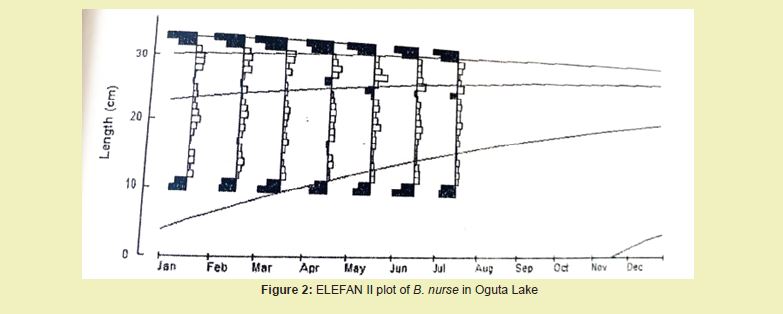
This study was for the provision of baseline information needed in the articulation of management strategies for sustainability in the Fishery of B. nurse and its conservation in Oguta Lake using ELEFAN II and VBGM predictions. The L∞ estimated was S.L = 35.70cm and the K-value was 0.24yr-1. Komolafe and Arowomo asserts that K-value lower than one, indicates slow growth.
B. nurse could live up to 5years in Oguta Lake and the growth rate is fastest between 0 and 1 year (about 29.57cmYr-1) reducing at older ages with the slowest between age 4 and 5 years (about 0.04cmYr-1).
In the new Calabar River:15 L∞ was 24.46cm, K = 0.52yr-1, M = 1.05yr-1, F = 0.83yr-1 and E = 0.26yr-1. In comparison, M was higher than F in both ecosystems. Also in this present study, the Exploitation (E) was 0.15yr-1 indicating that B. nurse is not over-exploited in Oguta Lake, considering that theoretically16 optimal exploitation level is M = F = 0.5. Again, the Emax estimated in Oguta Lake was 0.421yr-1 while E (0.15yr-1) was lesser than the Emax of 0.421yr-1. This species was also not experiencing over-exploitation in the new Calabar River. This could be attributed to the fact that B. nurse is widespread and resilience in most ecosystems and therefore could withstand fishery pressure.17
However, the Yield per recruit (Y’/R) show values lesser than 1 in Figure 6 implying that the stock is not operating at its Maximum Sustainable Yield (MSY). This calls for serious management concerns.
In addition, the Reproductive load of quotient (Lc/L∞=0.28) is too low and indicates that the stock cannot carry much Fishery Pressure in the Future as the fishes are being caught before they reach half their maximum potential size going by Froese18 postulations.
With the Fishing in Oguta Lake being unregulated, there is need to place restriction on the use of small mesh sizes for capture of B. nurse as too many small-sized individuals are being caught, which could be seen in the values of the Reproductive Load. The management strategy should focus on the closing of the Fishing season in the Lake around the identified recruitment peak of the month of May every year to avert future collapse of the Fishery.19
None.
This Research Article received no external funding.
Regarding the publication of this article, the authors declare that they have no conflicts of interest.
