

Background: Carpal tunnel syndrome (CTS) is the most prevalent peripheral compressive neuropathy, resulting from increased pressure within the carpal tunnel and subsequent median nerve dysfunction. Surgical release of the transverse carpal ligament remains the gold standard for moderate to severe or refractory cases.
Objective: To describe a novel minimally invasive surgical technique for carpal tunnel release and to evaluate its safety, reproducibility, and early clinical outcomes.
Methods: A retrospective descriptive study was conducted including patients diagnosed with CTS who underwent surgical treatment using the proposed technique between 2023 and 2025. The procedure involves a small transverse incision at the wrist flexion crease, blunt dissection, active protection of the median nerve using a malleable metallic spatula, and direct visualization of the transverse carpal ligament with an otorhinolaryngological speculum, followed by controlled ligament sectioning.
Results: A total of 282 patients were included. No intraoperative complications were observed. There were no cases of infection, median nerve injury, significant hematoma, persistent scar pain, or need for reoperation. All patients demonstrated satisfactory early postoperative outcomes.
Conclusion: The carpian rhinoscopic technique is a safe, reproducible, and cost-effective minimally invasive approach that enables complete ligament release under direct visualization with minimal tissue trauma. It represents a viable alternative to both open and endoscopic techniques.
Keywords: Carpal tunnel syndrome, Minimally invasive surgery, Transverse carpal ligament, Median nerve, Surgical technique
Carpal tunnel syndrome (CTS) is the most common compressive neuropathy of the upper limb and represents a significant cause of functional impairment and reduced quality of life. It results from increased pressure within the carpal tunnel, leading to ischemia and mechanical compression of the median nerve.
Since its systematic description in the early 20th century, surgical decompression through division of the transverse carpal ligament has been established as the definitive treatment for moderate to severe cases. The classical open technique, widely disseminated following the work of Phalen, has demonstrated high effectiveness; however, it is associated with well-documented drawbacks, including scar tenderness, pillar pain, delayed functional recovery, and prolonged absence from work.1,2
In response to these limitations, minimally invasive and endoscopic techniques have been developed with the aim of reducing surgical morbidity while preserving efficacy. Although endoscopic approaches offer advantages such as reduced scar-related symptoms and faster recovery, their adoption is limited by higher costs, the need for specialized instrumentation, and a steep learning curve.
Therefore, there remains a need for a surgical approach that combines the safety and completeness of open release with the reduced morbidity of minimally invasive techniques, while maintaining low cost and broad applicability.
This study introduces a novel minimally invasive method-the carpian rhinoscopic technique-and presents its technical description along with clinical outcomes from a substantial case series.
Study design and setting
A retrospective descriptive study was conducted at a single specialized center.
Patient selection
Patients were included if they met the following criteria:
- a. Clinical diagnosis of carpal tunnel syndrome
- b. Failure of conservative treatment
- c. Electroneuromyography performed when clinically indicated
Exclusion criteria
- a. Previous carpal tunnel surgery
- b. Congenital anatomical variations (e.g., bifid median nerve, persistent median artery)
- c. Rheumatoid arthritis or systemic connective tissue disorders
- d. Sequelae of distal radius fractures
Sample characteristics
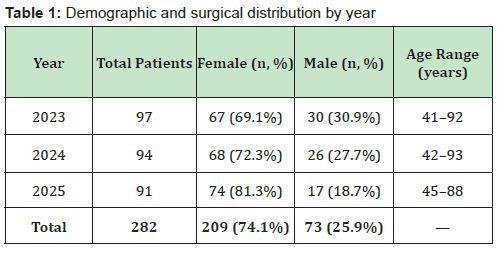
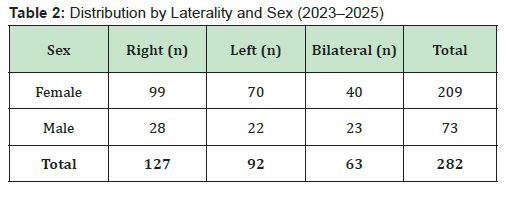
A total of 282 patients operated between 2023 and 2025 were included, reflecting the typical epidemiological distribution of CTS, with predominance in female patients.3
Ethical considerations
All procedures followed institutional standards and the principles of the Declaration of Helsinki. (Inserir aqui aprovação do comitê de ética, se aplicável.)
Surgical technique
Patient positioning and anesthesia
The patient is placed in the supine position with the affected upper limb supported on an auxiliary table. Local anesthesia is administered via infiltration in the palmar region, carpal tunnel, and distal forearm. Intravenous sedation is provided for patient comfort. A pneumatic tourniquet is applied to ensure a bloodless field.4
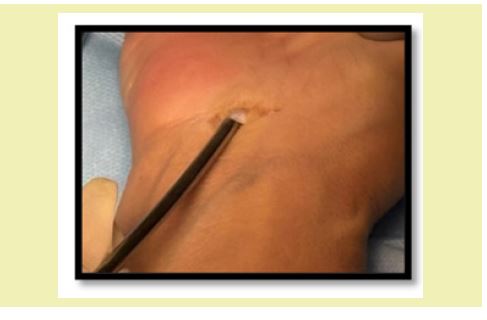
Step 1 – Surgical access
A small transverse incision is made along the wrist flexion crease. Blunt dissection is carefully performed until identification of the proximal edge of the transverse carpal ligament Figure 1.
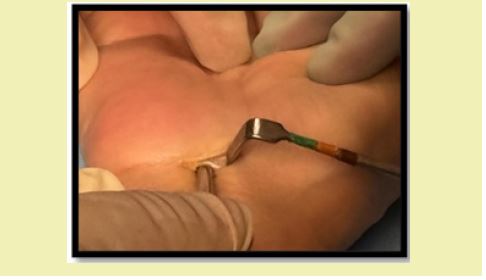
Step 2 – Median nerve protection
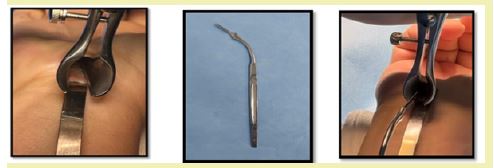
Two blunt retractors are inserted into the carpal tunnel to create a working space. A malleable metallic spatula is then introduced and positioned anterior to the median nerve, providing active protection throughout the procedure Figure 2.
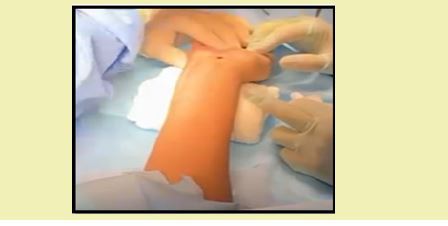
Step 3 – Wrist positioning
A padded support is placed on the dorsal aspect of the wrist, maintaining it in controlled extension. This positioning increases tunnel space and facilitates safer ligament exposure Figure 3.
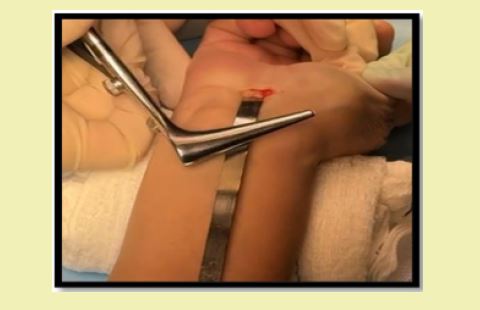
Step 4 – Ligament exposure
Blunt dissection is performed to separate soft tissues from the transverse carpal ligament. An otorhinolaryngological speculum is then inserted, allowing controlled expansion of the operative field and direct visualization of the ligament Figure 4.5
Step 5 – Ligament sectioning
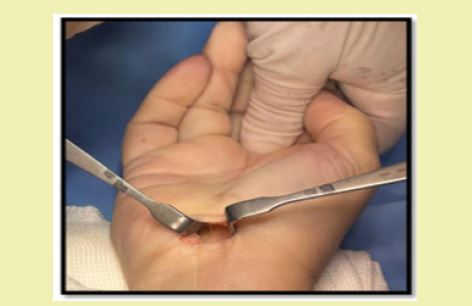
Using a specially designed scalpel (blade no. 15), adapted to the curvature of the extended wrist, the transverse carpal ligament is completely sectioned under direct visualization Figure 5.6
Step 6 – Forearm fascia release
The distal forearm fascia is dissected and released, ensuring complete decompression of the median nerve Figure 6.
Operative time
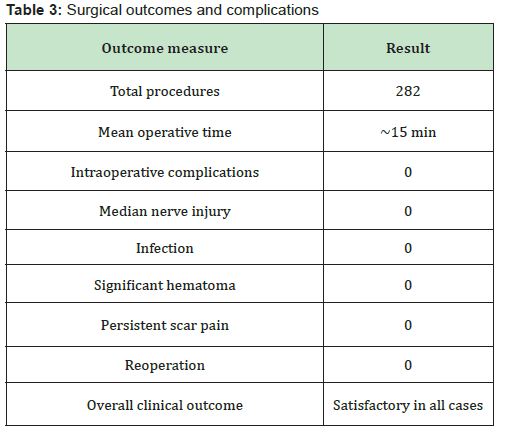
The mean operative time is approximately 15 minutes.
A total of 282 procedures were performed using the described technique.
- i. Intraoperative complications: None
- ii. Median nerve injuries: None
- iii. Infections: None
- iv. Significant hematomas: None
- v. Persistent scar pain: None
- vi. Reoperations: None
All patients demonstrated satisfactory early postoperative outcomes, with no clinically relevant adverse events observed Table 1-Table 3.
The carpian rhinoscopic technique integrates key principles of modern minimally invasive surgery: reduced incision size, preservation of surrounding tissues, and protection of critical neurovascular structures.
One of its main distinguishing features is the use of an otorhinolaryngological speculum, which enables direct visualization of the transverse carpal ligament. This represents a significant advantage over blind or semi-blind techniques, increasing procedural safety and surgical control.
The introduction of a malleable metallic spatula anterior to the median nerve provides an additional protective barrier, minimizing the risk of iatrogenic injury during ligament sectioning.7,8
Biomechanically, wrist extension plays an important role by increasing the volume of the carpal tunnel and reducing tendon pressure on the median nerve, thereby facilitating safer dissection and visualization. Compared with endoscopic techniques, this approach eliminates the need for specialized equipment and reduces procedural costs, making it particularly suitable for public healthcare systems and resource-limited environments.
Limitations of this study include its retrospective nature and the absence of long-term functional outcome measurements. Future prospective and comparative studies are necessary to validate these findings.
The carpian rhinoscopic technique is a safe, reproducible, and cost-effective minimally invasive method for carpal tunnel release.
It combines:
- I. Direct visualization of the transverse carpal ligament
- II. Active protection of the median nerve
- III. Short operative time
- IV. Minimal tissue trauma
This technique represents a practical and scalable alternative to both open and endoscopic approaches and may be widely adopted across diverse surgical settings.
None.
This Research Article received no external funding.
The authors declare no conflicts of interest relevant to this publication.
- 1. Phalen GS. Spontaneous compression of the median nerve at the wrist. JAMA. 1951;145:1128-1133.
- 2. Phalen GS. The carpal tunnel syndrome: seventeen years’ experience. J Bone Joint Surg Am. 1966;48:211-228.
- 3. Okutsu I, Hongo T, Sugiura H, et al. Endoscopic management of carpal tunnel syndrome. Arthroscopy. 1987;3:11-18.
- 4. Chow JCY. Endoscopic release of the carpal ligament. Arthroscopy. 1989;5:19-24.
- 5. Atroshi I. Open versus endoscopic carpal tunnel release. J Hand Surg. 2009;34:266-272.
- 6. M Skie, J Zeiss, NA Ebraheim, et al. Carpal tunnel changes during wrist motion. J Hand Surg. 1990;15:934-939.
- 7. Cobb TK. Effect of wrist position on carpal tunnel pressure. J Hand Surg. 1995;20:620-626.
- 8. Nakamichi K, Tachibana S. Ultrasonographic measurement of median nerve movement. J Hand Surg. 1992;17:213-217.
