

Background: Poly-L-lactic acid (PLLA) is a collagen-stimulating biomaterial widely used for facial bio-stimulation. Reports of palpable nodules with earlier formulations prompted interest in the role of microparticle morphology in suspension behavior and tissue distribution.
Legacy PLLA is characterized by irregular, “spiky” shapes, whereas second-generation PLLA (e.g., INFINI V10) employs PSMMT® technology, producing rounded/spherical particles.
Hypothesis: Rounded particles favor homogeneous dispersion and reduce inter-particle interlocking, potentially lowering agglomeration—a factor implicated in nodule formation.
Keywords: PLLA, Generations, Morphological findings
To characterize, via scanning electron microscopy (SEM), the morphological differences between spiky legacy PLLA and rounded second-generation PLLA, and to discuss their mechanistic implications for agglomeration and potential nodule development.
Samples
- a. Legacy PLLA (First-generation PLLA)
- b. Second-generation PLLA (e.g., INFINI V10)
Preparation
Dry powders mounted on conductive carbon–platinum tape; Au/Pd sputter coating (~5–8nm).
Imaging
Field-emission SEM; accelerating voltage 3–10 kV; magnification 2,000×–20,000×; working distance 5–10 mm.
Morphometric analysis (planimetry on SEM images)
- a. Circularity = 4πA/P² (1.0 = perfect circle)
- b. Aspect ratio (major/minor axis)
- c. Edge curvature radius (proxy for “spiky” projections)
- d. Particle size distribution (Feret diameter)
Analysis set
≥200 particles per product (random fields), two independent raters; discrepancies resolved by consensus.
Figures
Representative SEM micrographs at low (2k–5k×) and high (10k–20k×) magnification, with insets highlighting edge morphology.
Morphology
- a. Legacy PLLA displayed irregular geometries with angular projections and heterogeneous edges (“spiky”)
- b. Second-generation PLLA exhibited rounded/near-spherical particles with smoother contours and fewer sharp protrusions
- c. Particle size distribution was comparable; however, edge curvature radius was significantly larger (i.e., smoother) for second-generation PLLA1
Dispersion-relevant descriptors
- a. Higher circularity and lower aspect ratio in second-generation PLLA
- b. Larger edge curvature radius (blunter edges)
- c. Narrower size distribution, suggesting more predictable suspension behavior
Qualitative aggregation (dry fields)
- a. Legacy PLLA frequently formed interlocking clusters
- b. Second-generation PLLA tended to display adjacent contact without mechanical interlocking
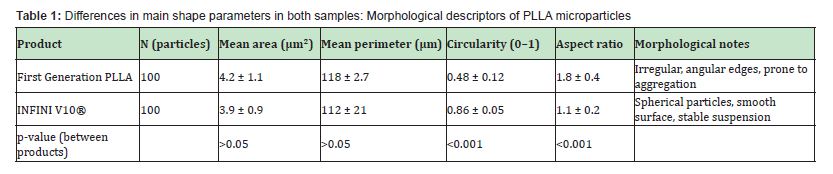
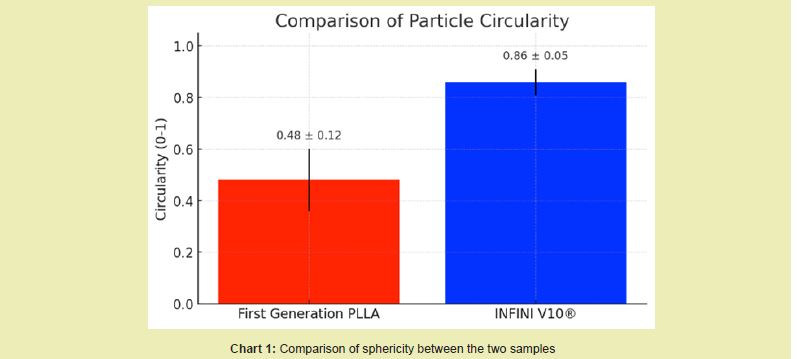
Quantitative morphometric analysis confirms that legacy PLLA presents with low circularity (0.48 ± 0.12) and high aspect ratio (1.8 ± 0.4), consistent with irregular, spiky morphology prone to interlocking. In contrast, INFINI V10 particles showed high circularity (0.86 ± 0.05) and near-unity aspect ratio (1.1 ± 0.2), reflecting a more spherical, homogeneous profile.2
These findings are summarized in Table 1 and visually illustrated in Chart 1 (bar chart), where second-generation PLLA demonstrates significantly higher circularity and reduced variability compared to Legacy PLLA. Micrographs further reinforce this contrast, highlighting the smooth, rounded surfaces of INFINI V10 versus the angular projections of legacy particles.
Mechanistic inference: Spiky projections promote mechanical interlocking and bridging flocculation, especially under shear stress during reconstitution or injection, leading to particle clustering. Rounded particles facilitate laminar flow, uniform dispersion, and lower clustering propensity.
Clinical relevance: Increased particle sphericity may result in more predictable tissue distribution and a reduced risk of nodule formation. Nonetheless, morphology is one among multiple factors (dilution, excipients, injection technique, tissue plane, patient factors). Optimized protocols—10mL reconstitution, retrograde delivery with 22G/25G cannula, avoidance of negative pressure, gentle massage—remain essential Chart 1, Figures 1-3.
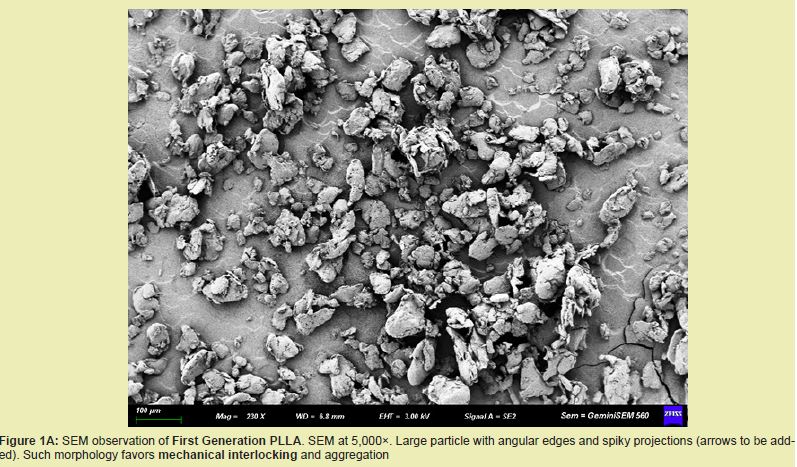
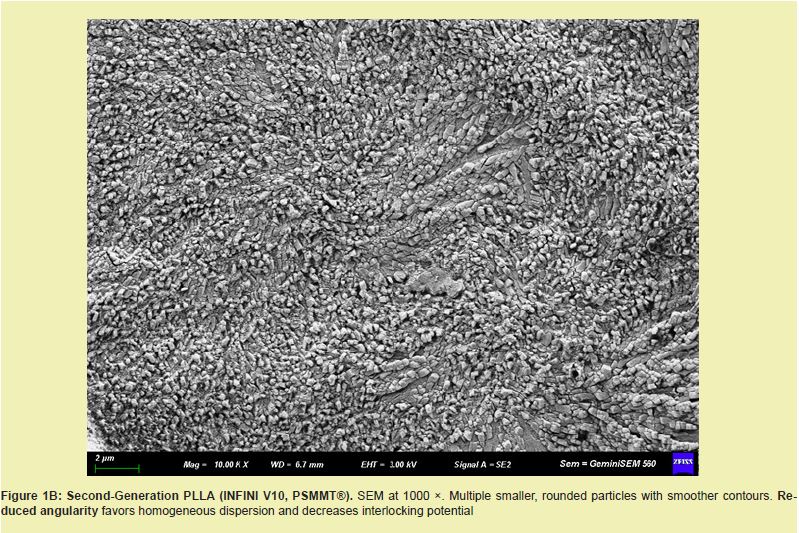
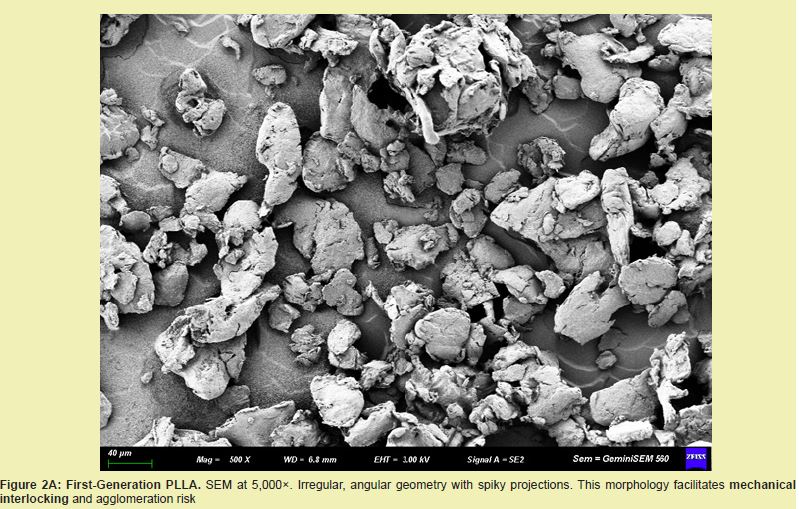
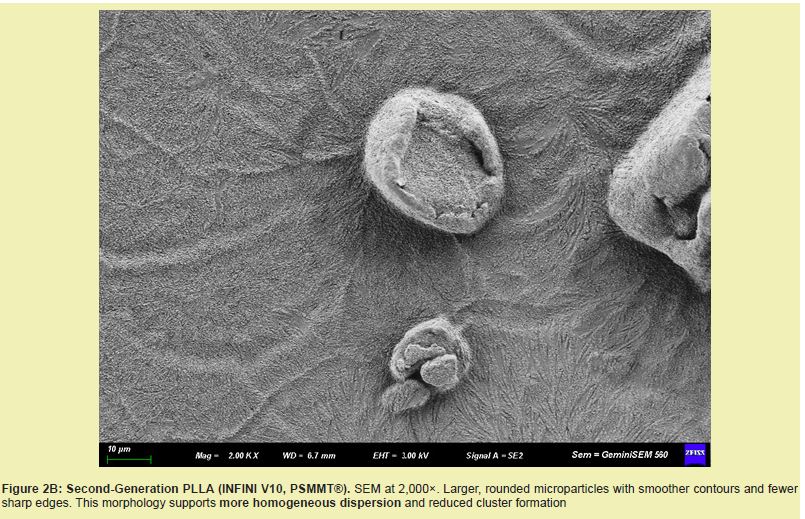
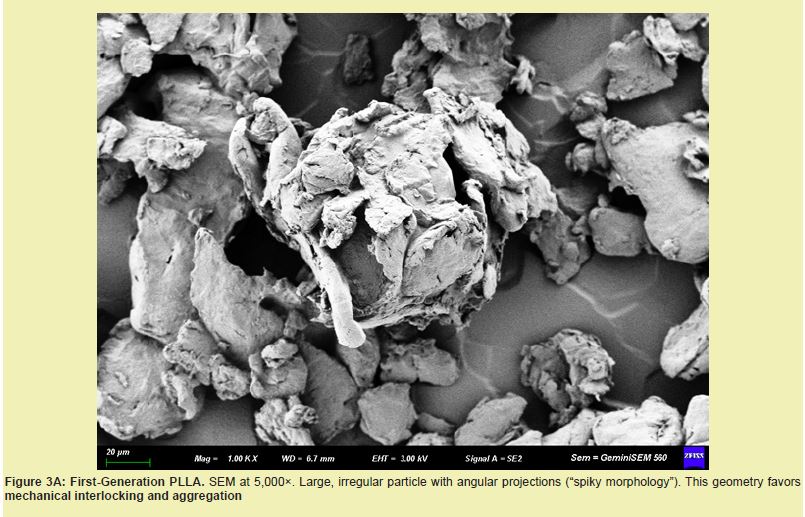
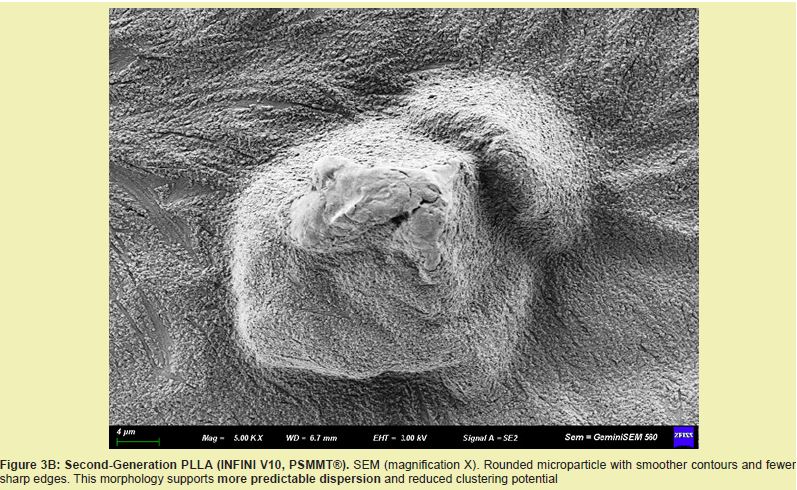
- i. SEM analysis demonstrates clear morphological differences between First and Second-generation PLLA.
- ii. Rounded particles exhibit higher circularity and smoother contours, supporting better suspension stability and lower aggregation potential.
- iii. Morphological findings provide a plausible mechanism for reduced nodule risk, but prospective clinical studies with standardized protocols and ultrasound monitoring are needed.
SEM is an ex vivo method; it does not model in-tissue dynamics. Excipients, reconstitution methods, injection planes, and patient variability were not controlled in this comparison. Clinical validation requires in vivo studies.
Circularity shape was determined by the following equation.3
Formula
Circularity=4π⋅AreaPerimeter2Circularity = \frac{4 \pi \cdot Area}{Perimeter^2}Circularity=Perimeter24π⋅Area
- a. Area = projected area of the particle
- b. Perimeter = outline length of the particle
A perfect circle has the maximum area-to-perimeter ratio → Circularity = 1.
Any irregularity (elongation, spikes, rough edges) increases perimeter relative to area, so circularity drops below 1.
Aspect ratio
Definition
The ratio between the longest axis (major axis) and the shortest axis (minor axis) of a particle’s projected image.
Aspect Ratio=Major Axis LengthMinor Axis LengthAspect\ Ratio = \frac{\text{Major Axis Length}}{\text{Minor Axis Length}}Aspect Ratio=Minor Axis LengthMajor Axis Length
- i. A perfect circle has the same length in all directions →AR=1.0AR = 1.0AR=1.0
- ii. More elongated or irregular shapes have higher AR values
Trademarks are the property of their respective owners (InfiniV10).
We thank the Center for Advanced Microscopy (UBA) and CONICET for access and technical assistance.
This Research Article received no external funding.
Regarding the publication of this article, the authors declare that they have no conflict of interest.
- 1. Mayra Ianhez J, et al. Complications of collagen biostimulators in Brazil: Description of products, treatments, and evolution of 55 cases. J Cosmet Dermatol. 2024;23:2829-2835.
- 2. J Min Lee, Y Jin Kim. Foreign Body Granulomas after the Use of Dermal Fillers: Pathophysiology, Clinical Appearance, Histologic Features, and Treatment Arch Plast Surg. Arch Plast Surg. 2015;42(2):232-239.
- 3. Chen Ying Su, You Cheng Chang, Bo Rong Lu, et al. Investigating the Relationship Between the Emulsification Parameters and Physical-Chemical Properties of Poly (D, L-lactic acid) Particles for Dermal Fillers. Polymers. 2024;16(23):3395.
