

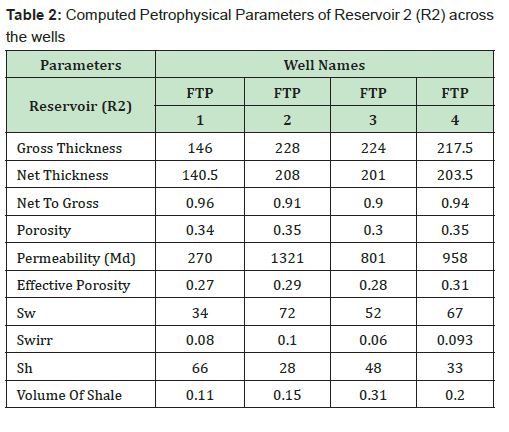
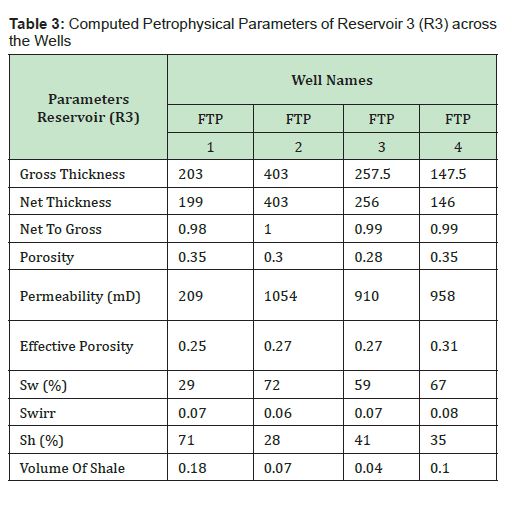
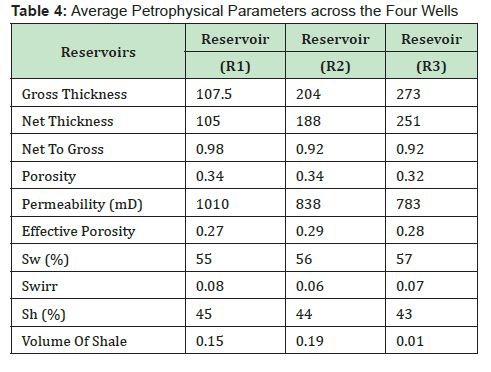
One challenging thing about doing formation evaluation studies in clastic formation like the Niger Delta is accurately identifying and mapping the reservoir sands and their edges. This is also true when studying the offshore Niger Delta. The database comprised borehole logs from four wells. Gamma ray logs were used to map the lithology while thye hydrocarbon bearing reservoirs were identified with a mix of gamma ray and resistivity logs. Well-logged correlation was carried out using similarity in log signatures. Schlumberger software (PETRELTTM) was used for interpretation. The computation of petrophysical parameters such as net-to-gross volume, volume of shale, porosity, permeability, and hydrocarbon saturation was done using standard equations. The general lithology in the area is an alternation of sands and shales. Three reservoirs designated as R1, R2, and R3 extend across all the wells. Reservoir R1 is located at a depth of 8244 m in well 1, 8202 m in well 2, 8167 m in well 3, and 8129 m in well 4. Reservoir R2 is located at a depth of 8843 m in Well 1, 8520 m in Well 2, 8478 m in Well 3, and 8448 m in Well 4. Likewise, reservoir R3 is located at a depth of 9508 m in well 1, 8801 m in well 2, 8758 m in well 3, and 8730 m in well 4. Reservoir R1 has an average net-to-gross sand of 0.98, a volume of shale of 0.15, porosity of 0.34, and permeability of 1010 mD. Reservoir R2 has an average net-to-gross sand of 0.92. The shale volume is 0.19, the porosity is 30%, and the permeability is 838 mD. Reservoir R3 has an average net-to-gross sand of 0.92. The shale volume is 0.01, the porosity is 0.30, and the permeability is 783 mD. The reservoir parameters were also represented statistically using a bar chart. These representations gave insight into the distribution of the reservoir parameters of interest in the study location.
Keywords: Petrophysics, Well log, Niger Delta, Reservoir, Hydrocarbon saturation
The global energy landscape continues to be heavily reliant on hydrocarbons, which represent a substantial portion of the world's energy supply. Despite the growing emphasis on renewable energy, the demand for oil and gas is expected to rise in the near term, driven by industrial growth, transportation needs, and economic development, especially in emerging markets.1 In this context, efficient exploration and development of hydrocarbon reservoirs are essential to ensuring a stable and secure energy supply.2
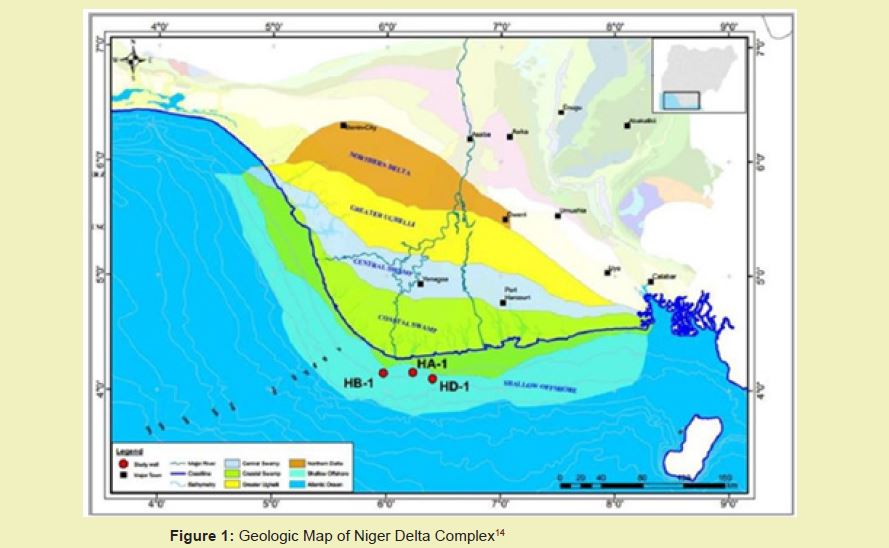
A reservoir, typically a subsurface rock with effective porosity and permeability, often contains a commercially exploitable quantity of hydrocarbons. Reservoir characterization refers to the comprehensive collection of relevant data necessary to effectively describe and understand a reservoir.3 This includes assessing the reservoir's capacity to store and produce hydrocarbons. A detailed understanding of the complete reservoir architecture is crucial, including its internal and external geometry, reservoir model, and the distribution of its properties. These properties are classified into static and dynamic categories: static properties such as porosity, permeability, heterogeneity, net pay, and thickness, and dynamic properties that refer to fluid flow within the reservoir. Knowledge of these characteristics enables the improvement of production rates, rejuvenation of oil fields, prediction of future reservoir performance, and cost reduction, while also supporting accurate financial modeling for oil company management.4 Reservoir characterization is a critical component of hydrocarbon exploration and production, requiring the integration of geological, petrophysical, and geophysical data to construct a comprehensive understanding of the reservoir’s structure, lithology, porosity, permeability, and fluid content.5 Among the various tools employed in reservoir characterization, well log data plays a central role. Geophysical well logs are invaluable in hydrocarbon formation evaluation, resource assessment, and studies related to groundwater, mineral deposits, geothermal energy, as well as paleoclimate or paleoenvironmental research.6 Wireline geophysical well logs provide continuous, sophisticated records of geophysical properties of boreholes and yield abundant geological information.7-9 For hydrocarbons to be produced, the pores and fractures within the reservoir must be interconnected, allowing hydrocarbons to flow toward production wells. Therefore, porosity and permeability are critical reservoir parameters, and significant hydrocarbon opportunities in regions like the Niger Delta Figure 1 have been identified across shallow, intermediate, and deep levels.10 The search for and economic development of oil and gas begins with the identification of promising geological provinces, followed by seismic surveying and drilling. Since the early 20th century, when Schlumberger introduced electrical resistivity logging,11 well log analysis has evolved significantly. Advances in well logging techniques, such as gamma ray, neutron, density, acoustic, nuclear magnetic resonance (NMR), and formation pressure logs, now provide detailed insights into reservoir characteristics.9 These technologies enable geoscientists to evaluate reservoir quality, identify fluid types, and estimate reserves with greater accuracy and confidence.12
In recent years, the integration of well log data with other geoscientific information has become increasingly important for modern reservoir characterization. By combining well log data with seismic data, core analysis, and geological mapping, a more accurate and comprehensive understanding of the reservoir can be obtained. This integration facilitates more informed decision-making in reservoir development and management.13 The aim of this research is to delineate hydrocarbon-bearing reservoirs and evaluate their petrophysical parameters through the integration of well log and seismic data.14
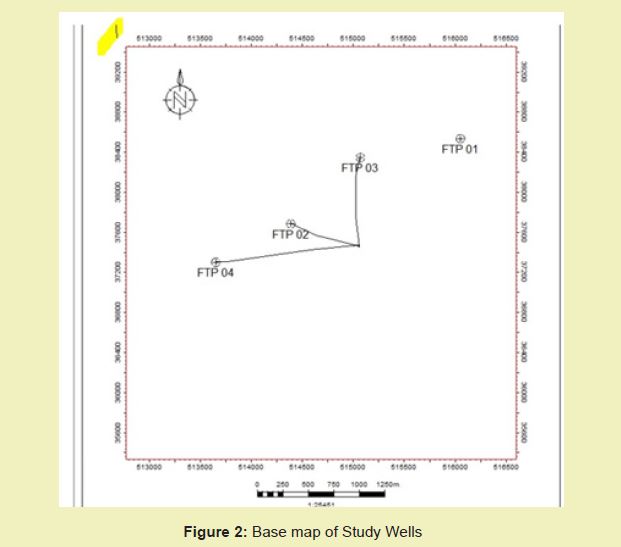
The data acquired from the “FTP” field in the Niger Delta area, Nigeria are Well log data which includes (The gamma ray), Well header and deviation data for four wells with use of petrel software for the interpretation Figure 2. This software was used to interpret and calculate the volume of hydrocarbon in “FTP” field.
Data importation
Data was imported accordingly to avoid errors. Quality control of the data was done alongside the importation of the data. The general workflow for importing into Petrel 2017 software are as follows: importation of well heads which was in the ASCII format, well deviation which was in the ASCII format, well logs which was in LAS format and check shot data. When these datasets were imported, quality control was also done to avoid error, that is incomplete data or wrong importation into Petrel.
The interpreted result can be grouped into lithology, well correlation, petrophysical and statistical representation of petrophysical parameter
Lithologic interpretation of studied wells
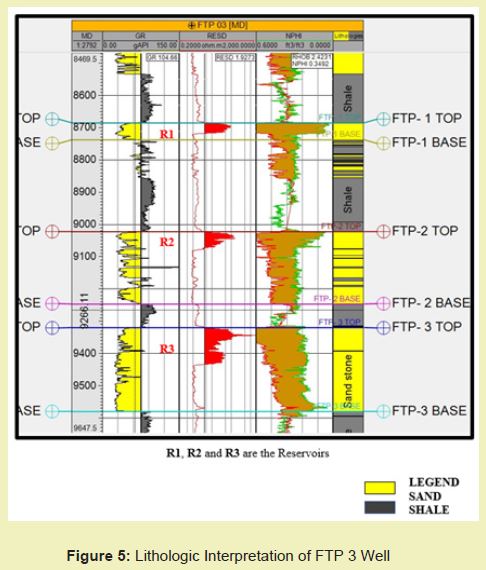
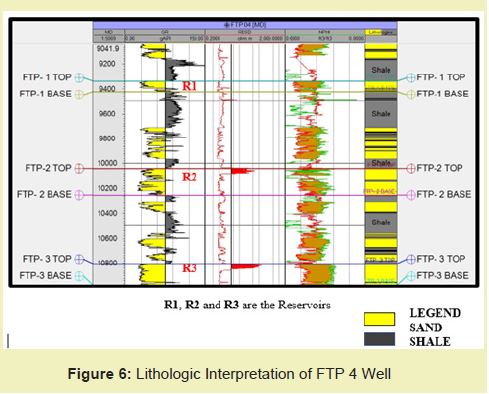
The suite well logs available in the study area include gamma ray, resistivity, density, neutron, sonic, and caliper logs. The major lithologic units penetrated by the wells are alternating sand and shale unit. The thickness of sand units decreases with depth with a corresponding increase in those shales.
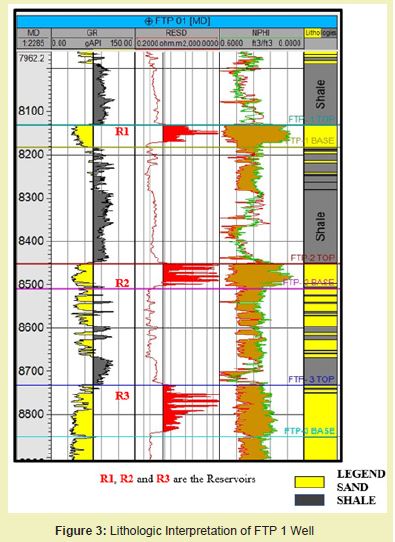
FTP WELL 1 covers a depth interval of 4079-9704 m subsea Figure 3. The rock unit penetrated by the well is alternating sand and shale layers, typical of the Agbada formation. The thickness of sand unit decreases with depth, with a corresponding increase in shale units. The sand units serve as reservoir rocks while shales serve as seal/cap rocks to the reservoirs. Three reservoirs exist at depth of 8131 m, 8450 m, 8731 m and 9391 m denoted as R1, R2 and R3
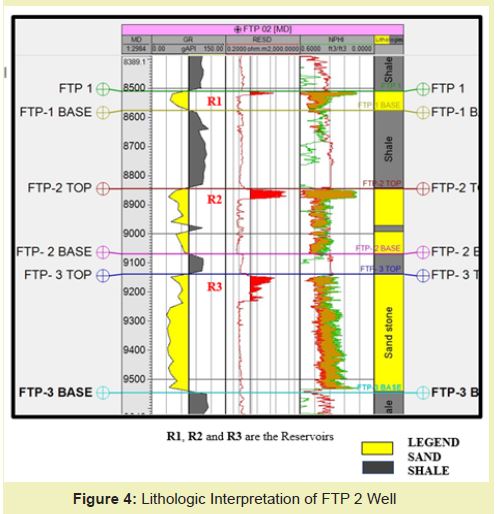
FTP WELL 2 covers a depth interval of 4588 m - 9521 m subsea Figure 4. The rock unit penetrated by the well is alternating sand and shale layers, typical of the Agbada formation. The thickness of sand unit decreases with depth, with a corresponding increase in shale units. This is in line with the study conducted by Ayuk MA15 in Integrating rock physics and sequence stratigraphy for characterization of deep-offshore turbidite sand system. The sand units serve as reservoir rocks while shales serve as seal/cap rocks to the reservoirs. Three reservoirs exist at depth of 8202 m, 8520 m and 8801 m denoted as R1, R2 and R3.
FTP WELL 3 covers a depth interval of 4579-9561 m subsea Figure 5. The rock unit penetrated by the well is alternating sand and shale layers, typical of the Agbada formation. The thickness of sand unit decreases with depth, with a corresponding increase in shale units.The sand units serve as reservoir rocks while shales serve as seal/cap rocks to the reservoirs. Three reservoirs exist at depth of 8167 m, 8478 m and 8758 m denoted as R1, R2 and R3.
FTP WELL 4 covers a depth interval of 762-11005 m subsea Figure 6. The rock unit penetrated by the well is alternating sand and shale layers, typical of the Agbada formation. The thickness of sand unit decreases with depth, with a corresponding increase in shale units. The sand units serve as reservoir rocks while shales serve as seal/cap rocks to the reservoirs. Three reservoirs exist at depth of 8129 m, 8448 m and 8730 m denoted as R1, R2 and R3.
Well log correlation
Figure 7 shows the well log correlation panel of the field it is composed of FTP wells 1,2,3 and 4. The correlation panel trends from north to south direction and it is composed of four wells. The general stratigraphy is alternation of sand and shales typical of the Agbada formation. The shale units are very thick and extend across all the wells the sand units are thin and constitute the reservoir units. In the same vein,16 conducted research on Reservoir characterization of GABO field in the Niger delta basin using facies and petrophysical analyses and discovered that the shall units are very thick which extend across all the wells.
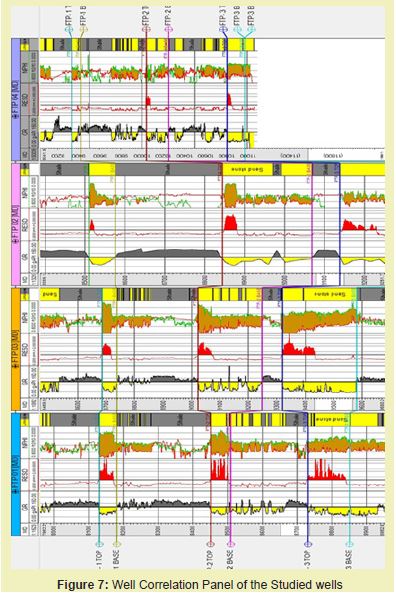
This sand and shale intercalations are typical of a deep-water environment. The reservoirs are located at different depth across the four wells. This is due to faulting in the study location. Reservoir R1 is located at depth of 8244 m in well 1, 8202 m in well 2, 8167 m in well 3 and 8129 m in well 4. Reservoir R2 is located at depth of 8843 m in well 1, 8520 m in well 2, 8478 m in well 3 and 8448 m in well 4. Likewise, reservoir R3 is located at depth of 9508m in well 1, 8801m in well 2, 8758 m in well 3 and 8730 m in well 4.
Petrophysical Analysis
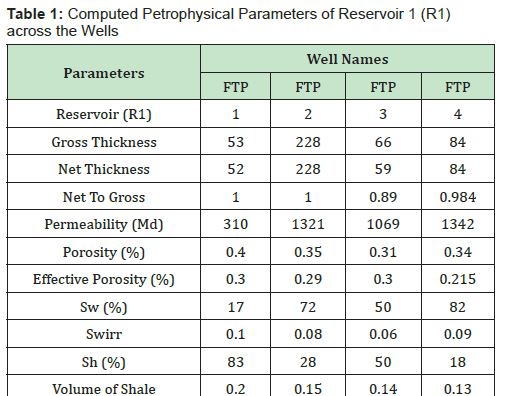
The reservoir properties of FTP 1, 2, 3 and 4 wells were calculated and presented in Table1 - Table 4. The computed average petrophysical parameters of interest for reservoir 1 (R1) include gross thickness of 107.5 m and net sand thickness 105 m, net-to-gross ratio of 0.98, volume of shale 0.15, porosity of 0.34, effective porosity of 0.27, water saturation 55%, hydrocarbon saturation 45% and permeability of 1010 mD. Reservoir 2 (R2) has an average gross thickness of 204m and net sand thickness 188 m, net-to-gross ratio of 0.92, volume of shale 0.19, porosity of 0.34, effective porosity of 0.29, water saturation 56%, hydrocarbon saturation 44% and permeability of 838mD. Reservoir 3 (R3) has an average gross thickness of 273 m and net sand thickness 251 m, net-to-gross ratio of 0.92, volume of shale 0.01, porosity of 0.32, effective porosity of 0.28, water saturation 57%, hydrocarbon saturation 43% and permeability of 783mD. Those value demonstrate that the reservoir exhibit good inter-pore connectivity, which is expected to have effective porosity and permeability within a good range. Table 4 displays the average computed petrophysical parameters for reservoir R1, R2 and R3, confirming the high permeability and effective porosity of reservoir R1, R2 and R3.
Statistical representation of computed petrophysical parameters
The computed petrophysical parameters were also represented in the form of bar charts, 3-D clustered column, 3-D stacked area.
Bar chart
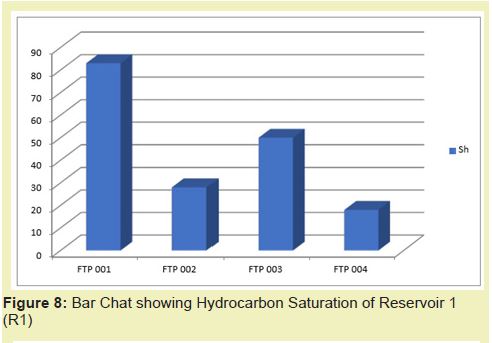
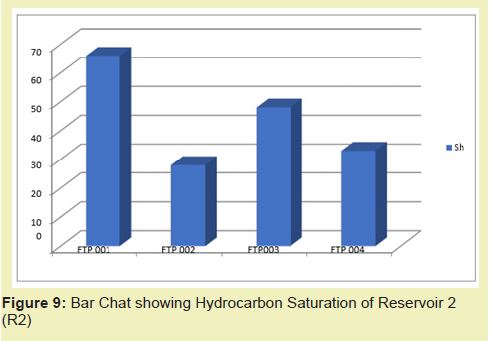
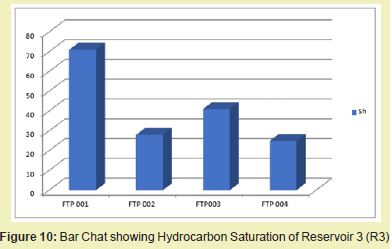
The bar chat represents petrophysical parameter in the form of distinct bars it represents the hydrocarbon saturation of each reservoir across the wells. It also shows the average effective porosity and permeability of the reservoir across the wells. Reservoir 3 has the highest hydrocarbon saturation of 83% in FTP 001, followed by FTP 003 with 50%. Reservoir 1 in FTP 004 and FTP 002 have hydrocarbon saturation of 18% and 28% respectively Figure 8. Reservoir 2 has the highest Hydrocarbon saturation of 66% in FTP 001, followed by FTP 003 with hydrocarbon saturation of 48%. In FTP 002 and FTP 004 have hydrocarbon of 28% and 33% respectively Figure 9. Reservoir 3 has the highest Hydrocarbon saturation of 71% in FTP 001, followed by FTP 003 with hydrocarbon saturation of 41%. In FTP 002 and FTP 004 have hydrocarbon of 28% and 25% respectively Figure 10.
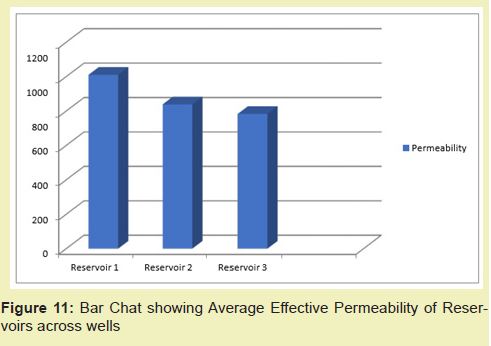
Reservoir 1 has the highest average permeability with 1010 mD, while Reservoir 2 and Reservoir 3 has 838 mD and 783 mD respectively Figure 11.
For the purpose of lithology and hydrocarbon saturation, geophysical wireline logs have been examined to identify reservoir unit and correlation of reservoir across the wells. Petrophysical parameter of the reservoir have been calculated to infer productive capabilities of reservoir sand. Well log further gave insight into the deformation of the rock units and lateral continuity. Shales and sand alternate in the general stratigraphy. The predominant kind of rock is shale, and the sand unit act as reservoir rocks. Three reservoirs designated as R1, R2 and R3 extend across all the wells. Reservoir R1 is located at depth of 8244 m in well 1, 8202 m in well 2, 8167 m in well 3 and 8129 m in well 4. Reservoir R2 is located at depth of 8843m in well 1, 8520 m in well 2,8478 m in well 3 and 8448 m in well 4. Likewise, reservoir R3 is located at depth of 9508 m in well 1, 8801 m in well 2, 8758 m in well 3 and 8730 m in well 4. Reservoir R1, has average net to gross sand of 0.98, volume of shale 0.15, porosity 0.34 and permeability 1010 mD. Reservoir R2, has average net to gross sand of 0.92. volume of shale 0.19, porosity 30% and permeability 838 mD. Reservoir R3, has average net to gross sand of 0.92. volume of shale 0.01, porosity 0.30 and permeability 783 mD. The reservoir parameters were also represented statistically using bar chart. These representations gave insight into the distribution of the reservoir parameters of interest in the study location.
Geophysical wireline log has been analyzed and interpreter for lithology and hydrocarbon saturation. It is therefore recommended that:
- i. The wells should be extended to deeper depth to explore for prospective reservoirs
- ii. Identified reservoirs should be followed lateral where possible to increase reserve
- iii. 3D seismic structural data is essential to unravel the structural frame work
- iv. Biostratigraphy data should also be included to determine the age of the reservoirs
None.
This Research Article received no external funding.
Regarding the publication of this article, the authors declare that they have no conflict of interest.
- 1. International Renewable Energy Agency-IRENA. World Energy Transition Outlook. 2023.
- 2. Bataee M, Al Jarmouzi AH, Shahbazi A, et al. A new approach in reservoir characterization using artificial intelligence. In Offshore Technology Conference 2023 (Article No. OTC-32602-MS). Society of Petroleum Engineers.
- 3. Chopra S, Michelena RJ. Introduction to this special section: Reservoir characterization. The Leading Edge. 2011;30(1):35-37.
- 4. Ameloko AA, Omali AO. Reservoir characterization and structural interpretation of seismic profile: A case study of Z-Field, Niger Delta, Nigeria. Petroleum and Coal. 2013;55(1):37-43.
- 5. Shah MS, Khan MHR, Rahman A, et al. Petrophysical evaluation of well log data for reservoir characterization in Titas gas field, Bangladesh: A case study. Journal of Natural Gas Science and Engineering. 2021;95:104129.
- 6. Lai J, Su Y, Xiao L, et al. Application of geophysical well logs in solving geologic issues: Past, present, and future prospects. Journal of Petroleum Science and Engineering. 2024;15(3):101779.
- 7. Farrag AF, Badry ME, Salem MG, et al. Improving reservoir characterization by integration of conventional log analysis with well test data: A case study from the Abu Madi reservoir, Nile Delta, Egypt. Journal of Petroleum Science and Engineering. 2019;172:748-760.
- 8. Marzan AH, Rahman MS, Rahman MS. Petrophysical evaluation using well logs for reservoir characterization: A case study from Bangladesh. Geosciences. 2021;11(1):1-13.
- 9. Lai JG, Wang Q, Fan X, et al. Geophysical well log evaluation in the era of unconventional hydrocarbon resources: A review on current status and prospects. Surveys in Geophysics. 2022;43:913-957.
- 10. Olowokere MT. Amplitude and fluid contact mapping in some parts of Niger Delta using seismic attribute analysis and inversion. Pacific Journal of Science and Technology. 2009;10.
- 11. Schlumberger, 2013. Log Interpretation Charts. Schlumberger Publication SurvGeophys. 2022;43:913-957.
- 12. Gonzalez JM, Tomlinson JE, Martínez Ceseña EA, et al. Designing diversified renewable energy systems to balance multisector performance. Nature Sustainability. 2023;6(4):415-427.
- 13. Akinlabi IA, Abiodun AO. Integration of seismic and well log data for reservoir characterization in offshore Niger Delta, Nigeria. Journal of Geography, Environment and Earth Science International. 2024;28(6):1-11.
- 14. Akana TS, Akpofure E. Grain size analysis of beach sediments from Bonny Beach in the Niger Delta. International Journal of Geology and Mining. 2019;5(2):245-257.
- 15. Ayuk Michael Ayuk, Oluwaseun Daniel Akinyemi, Muraina Zaid Mohammed. Integrating rock physics and sequence stratigraphy for characterization of deep-offshore turbidite sand system. Journal of African Earth Sciences. 2022;193:104592.
- 16. Horsfall Opiriyabo Ibim, Mfonobong Joseph Akpan, Nyakno Jimmy George. Reservoir characterization of GABO field in the niger delta basin using facies and petrophysical analyses. Results in Earth Sciences. 2024;2:100038.
